
The Warranty Claim Is Closed. Has the Quality Problem Been Solved?
The Supplier Change Notice Is Only the Beginning
A customer reports a failed component. The service team arranges a replacement, processes the warranty claim and closes the case.
The customer has received support. The financial transaction is complete. But one question remains: does the manufacturer understand why the component failed?
For quality and warranty leaders, that distinction matters. A closed claim can confirm that an individual case was handled without establishing whether the underlying issue could affect other products.
Warranty management should help manufacturers connect complaints, repairs and costs with the investigations those events warrant. The objective is to resolve customer issues while ensuring that relevant evidence reaches the people responsible for product and process improvement.
Claim Closure and Quality Resolution Answer Different Questions
Warranty administration addresses practical questions. Is the claim eligible? What repair or replacement is appropriate? Has the necessary documentation been reviewed? What costs
should be recorded?
Quality investigation asks something different. What happened? Why did it happen? Could it happen elsewhere? What evidence would demonstrate that corrective action worked?
These activities may proceed on different timelines. A customer should not have to wait for a full investigation before receiving an appropriate remedy. Equally, completing that remedy should not automatically end the investigation.
An effective warranty process makes both statuses visible. Teams should be able to distinguish a processed claim from an unresolved technical issue without reopening the entire administrative case to understand what remains outstanding.
Where the Handoff Can Break Down
Consider a hypothetical manufacturer of industrial pumps.
Several customers report leaks after a period of operation. Each claim arrives separately, and service teams replace the affected seals. The individual records show completed repairs.
However, the descriptions vary. One report says, “seal failure,” another says, “fluid leak,” and a third records only the replacement part. Operating conditions and time in service are inconsistently documented.
Quality engineers now have to establish whether these cases share a failure mechanism or simply look similar.
The cause might involve a component defect, an assembly issue, operating conditions or another factor. The claims alone do not establish the answer. They provide the starting evidence.
If repair information, returned-part findings and claim costs remain scattered across separate records, that investigation becomes harder to organize. The handoff needs enough context for quality teams to act without rebuilding every case from emails.
Capture Information That Supports an Investigation
Useful warranty data starts with a clear account of the reported problem.
Manufacturers should define the information needed for their products and service arrangements. Depending on the situation, that may include product identification, the reported symptom, operating conditions, time in service, repair findings and whether the failed component is available for examination.
It also helps to distinguish observations from conclusions.
“Fluid visible around the seal after operation” describes an observation. “Defective supplier seal” assigns a cause that still needs evidence.
Review checklists can help teams identify missing information before a claim progresses. Clear descriptions and consistent terminology also make records easier to compare.
The goal is to collect enough reliable information to support the next decision, without turning every service interaction into an unnecessarily lengthy investigation.
Decide Which Claims Need Further Action
Not every warranty claim requires a formal 8D investigation.
Manufacturers should establish escalation criteria appropriate to their products, customer requirements and risks. A recurring symptom, an unusual concentration of failures, significant costs or a potentially serious consequence may justify further review. A single serious failure may warrant attention even when claim volume is low.
The decision should have an owner, a rationale and a defined next step.
When a structured investigation is appropriate, ASQ’s eight disciplines problem-solving framework distinguishes containment, verified root causes, corrective action and effectiveness validation. That distinction helps teams avoid treating a replacement or temporary remedy as proof that the cause has been addressed.
Warranty records should provide the evidence and context needed to begin that work. The investigation should then establish what action is justified.
Make Costs Visible Without Losing the Technical Context
Warranty costs help leadership understand the financial significance of claims and prioritize further review.
But cost totals need context. A costly repair does not automatically indicate a widespread defect. A low-cost claim may still reveal a serious issue.
Likewise, raw claim counts do not establish a failure rate. Comparing performance across products may require information about units in service, product age, usage and reporting delays.
A useful management review brings financial and technical perspectives together. Which complaints deserve investigation? Which actions remain open? What is the recorded cost of the affected claims? What information is still missing?
The purpose is to support decisions about where to investigate and allocate resources, while keeping the limitations of the available data visible.
How Empower QLM Supports Warranty Management
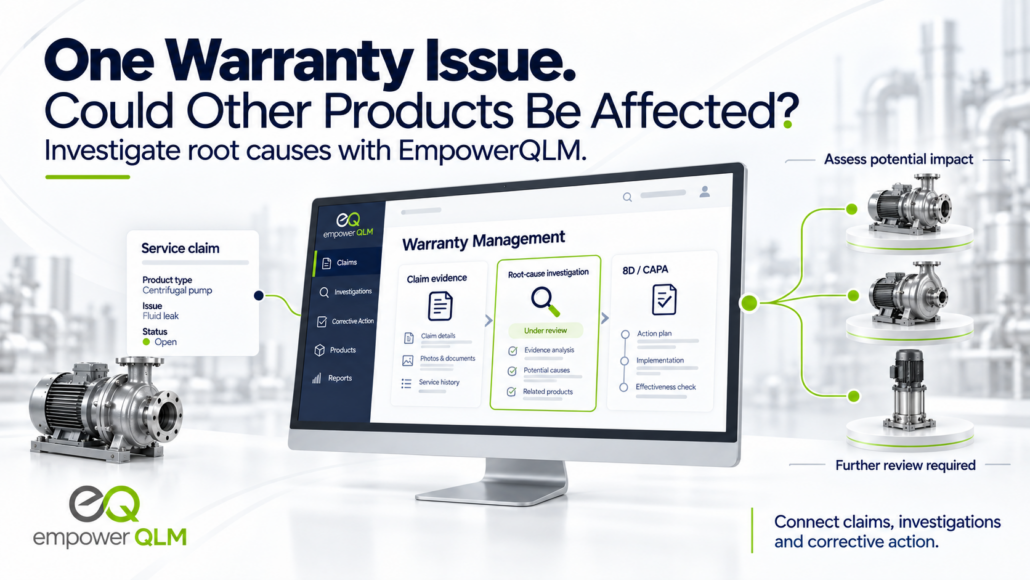
Empower QLM’s Warranty Management module supports complaint capture, repair-order creation and warranty claim processing within the OEM warranty workflow. It also supports 8D and CAPA for claim resolution, with configurable resolution templates.
These capabilities give manufacturers a way to organize claim handling alongside structured quality resolution.
Complaint and claim handling: Teams can capture complaints, create repair orders and process warranty claims as part of the warranty workflow.
Consistent reviews: Review checklists help standardize claim assessment. Configurable acknowledgment features can accommodate plant-specific needs.
Structured resolution: Support for 8D and CAPA allows manufacturers to use established problem-solving approaches when a claim requires further investigation.
Data exchange: Warranty claim information can be imported through Excel or direct integrations. API capabilities support exchanges with external systems, subject to the integration being implemented.
Financial visibility: Teams can add and monitor warranty cost information. Dashboards provide visibility into warranty counts and costs, with business intelligence integration supporting user-specific views.
The value depends on how these capabilities are configured and used. Teams still need clear escalation criteria, reliable information and responsibility for investigating issues and evaluating results.
Define What “Resolved” Means
Before closing a quality investigation, teams should agree on the evidence required to demonstrate effectiveness.
For the hypothetical pump manufacturer, that might include testing under relevant operating conditions and monitoring products built after an implemented change. The appropriate method depends on the verified cause and the action taken.
Field evidence also takes time. An absence of new claims immediately after a change may provide limited reassurance if the original failures appeared only after months of use.
Manufacturers need a deliberate connection between the customer’s complaint, the investigation and the evidence supporting resolution.
A warranty claim can be closed because the customer has been supported and the transaction completed. Confidence that the quality problem has been addressed requires its own evidence.
Explore Explore Empower QLM to discuss how Warranty Management can support complaint handling, claim reviews, cost visibility and structured resolution through 8D and CAPA.
Frequently Asked Questions
What is warranty management in manufacturing?
Warranty management is the process of receiving, reviewing and resolving warranty claims, including coordinating repairs or replacements and tracking associated costs. It can also provide information for quality investigations and corrective actions.
What is the difference between closing a warranty claim and resolving a quality problem?
Closing a warranty claim means the required administrative and customer remedy steps are complete. Resolving the underlying quality problem requires understanding its cause, implementing appropriate action and evaluating whether that action was effective. The two activities may finish at different times.
Does every warranty claim require an 8D investigation?
No. Manufacturers should determine the appropriate response based on the issue’s severity, recurrence, customer requirements and potential impact. A formal 8D may be appropriate for significant or recurring problems that require structured investigation across multiple functions.
What information helps quality teams investigate warranty claims?
Useful information may include product and component identification, reported symptoms, operating conditions, time in service, repair findings and returned-part availability. Teams should distinguish observed facts from suspected causes so that an initial assumption does not become an unsupported conclusion.
How does Empower QLM support warranty management?
Empower QLM’s Warranty Management module supports complaint capture, repair orders, warranty claim processing, review checklists and warranty cost tracking. It also supports 8D and CAPA for claim resolution, configurable resolution templates, and dashboards showing warranty counts and costs.
Can Empower QLM import warranty data from other systems?
The module supports Excel imports, direct integrations and API capabilities for exchanging information with external systems. The specific data exchanged and the degree of automation depend on the integration implemented.
About Us
RGBSI’s quality division and EmpowerQLM software address the COPQ problems covered in this article through a combined services and platform model. RGBSI supports manufacturers with COPQ baseline studies, supplier chargeback recovery programs, PPAP and APQP execution support, supplier development, audits, 8D problem solving, and warranty-related quality services. These services help manufacturers identify hidden cost categories, quantify supplier-driven losses, and establish defensible recovery mechanisms.
EmpowerQLM provides the workflow infrastructure to operationalize that model. NC Management captures nonconformances at the point of failure. CoPQ Management links cost fields, chargeback workflows, and recovery status to NCs, 8Ds, CAPAs, PPAPs, and warranty records. Warranty Management connects field claims to financial exposure and recurrence analysis. Supplier Scorecards bring quality cost into supplier performance discussions. ERP and finance-system integration support debit and credit note tracking, so quality cost can move from hidden overhead to attributable financial governance.
Together, RGBSI and EmpowerQLM help enterprise manufacturers make COPQ visible, recoverable, and preventable. More detail on the services side is available through EmpowerQLM Quality Management Services.
Download Empower QLM Software Overview Brochure