
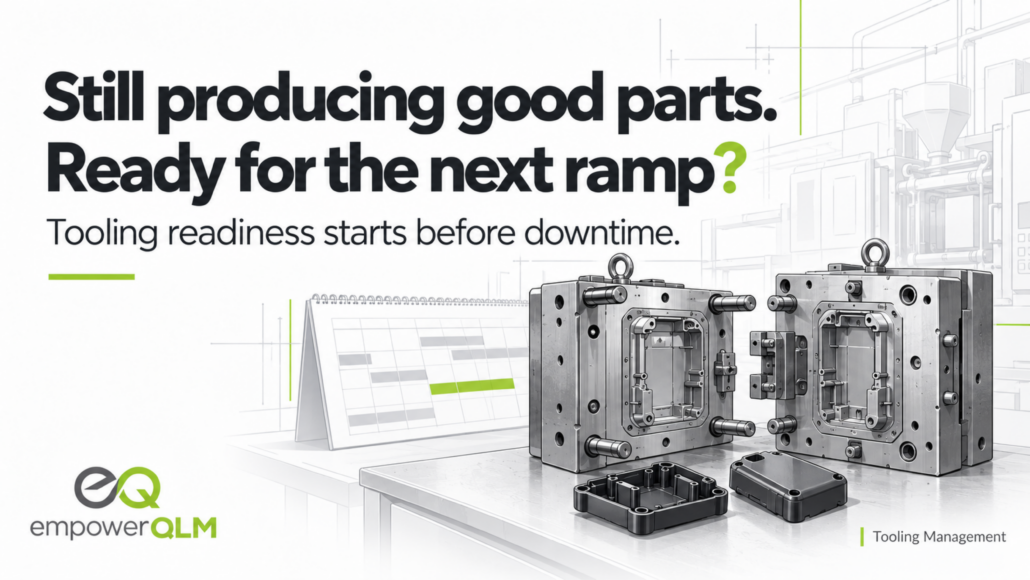
The Tool Is Still Running. Will It Last Through the Next Production Ramp?
A tool producing acceptable parts today still needs a plan for maintenance, refurbishment, and eventual replacement. The practical question is whether that plan supports the production schedule ahead.
Consider a hypothetical supplier producing molded housings for an assembly plant. Deliveries are on time, and the latest inspection results meet requirements. The customer increases its forecast for the next quarter.
During the planning review, someone asks when the mold was last refurbished. Purchasing has the original tooling order. Supplier quality has an earlier trial report. The supplier has maintenance records, but no one has brought those records together with current usage and the new forecast.
Nothing in that situation proves the mold is about to fail. It does reveal an unanswered question: what evidence supports relying on it through the next production ramp?
Start with the specific tool behind the production plan
A part number alone may not identify the tooling exposure. The same part might run on more than one tool, while a single tool may support several related parts.
Before discussing remaining life, establish which tool is in use, where it is located, who owns it, and which products depend on it. Confirm whether an alternative tool is available and what would be required to put it into production.
In the housing example, a spare mold listed in an asset register might still need repairs or a production trial. Calling it a backup does not establish that it can support the required schedule.
This is why a tooling review should connect the physical asset with the people and production commitments that depend on it.
Separate usage estimates from evidence of condition
Tool usage is useful planning information, but the basis matters.
Received quantities describe accepted deliveries. They may exclude rejected parts, trial runs, and production still held at the supplier. For a mold producing multiple parts per cycle, received parts also cannot simply be treated as an equivalent number of shots.
A cycle or shot counter provides another view of use. Neither measure, by itself, establishes the physical condition of the tool.
Teams should review usage alongside maintenance history, repairs, inspection observations, and relevant production results. If dimensions begin changing or maintenance interventions become more frequent, investigate the cause rather than assuming tool wear is responsible.
For the housing supplier, the useful outcome is a documented assessment: what is known about this mold, which assumptions remain uncertain, and what needs checking before the higher demand begins?
Work backward from the date support will be needed
The decision date for replacement tooling comes before the date the existing tool becomes unusable.
A replacement may require design work, manufacture, trials, adjustments, and applicable customer approvals. Refurbishment also requires planning, including time away from production and evidence that the tool can return to service.
Consider a simplified planning example. The supplier estimates that a mold should be reviewed for refurbishment in roughly four months under the revised production plan. The proposed work requires a shutdown, and the customer has a major build scheduled during that period.
The immediate task is to validate the estimate and agree on a workable maintenance window. Waiting for a breakdown would remove options that are available now.
Purchasing, operations, supplier quality, and the supplier should agree on the decision owner, required evidence, timing, and production coverage. A plan awaiting commercial approval should remain visibly unresolved.
Make periodic confirmation useful
A recurring request asking whether a tool is “available” can produce a reassuring answer without establishing much.
A useful confirmation asks for information that supports a decision:
● Is the identified tool at the expected location and assigned to the expected parts?
● What maintenance or repairs have occurred since the previous review?
● What current evidence supports its readiness for the planned work?
● Is refurbishment or replacement being considered, and who owns the next action?
● What is the production plan while the tool is unavailable?
The evidence should match the risk and the decision. A photograph can help confirm identity or visible condition. It cannot establish dimensional performance or prove that a tool will last through a forecast period.
Returning to the housing example, a current trial report and maintenance review may support continued use with a scheduled follow-up. Alternatively, the review may reveal that refurbishment needs to be approved sooner. Either outcome is more useful than unexplained green status.
How Empower QLM supports tooling management
Empower QLM’s tooling capabilities help teams organize internal and supplier tooling records and the workflows around them.
Tooling Management supports a globally accessible tool master with supplier portal access. Teams can track tools by supplier, part number, and manufacturing plant, including ownership and tool-to-part relationships.
Supplier readiness and periodic reconfirmation workflows support submissions such as tool images and trial reports. Refurbishment, replacement, scrapping, and relocation workflows help structure the follow-up when a tool needs attention.
The module also supports tool end-of-life estimates based on goods receipts. Those estimates should be interpreted against the underlying production assumptions and condition evidence.
For deployments using the separate Integrated Tool Life & Tracking Monitoring Device capability, shot-based monitoring provides another source of usage information. Hardware monitoring and receipt-based estimates are distinct approaches, and neither replaces engineering judgment about the tool’s condition.
The practical benefit is a clearer record of the tool, the supporting evidence, and the work required to keep production supported.
Review critical tooling before the next ramp
Start with one tool whose loss would interrupt a priority program. Bring its identity, usage information, maintenance history, and planned production demand into the same review.
Then establish the next decision, its owner, and the evidence needed to make it.
Request an Empower QLM demo to explore supplier tooling records, readiness confirmations, and refurbishment or replacement workflows around your production needs.
Frequently Asked Questions
Does an acceptable part prove the tool is in good condition?
It establishes that the inspected characteristic met its requirement for that part. Assessing tool condition requires relevant maintenance, usage, and technical evidence.
Can received quantities show exactly how many times a tool has run?
No. Receipts may differ from total production activity. Trial runs, scrap, inventory timing, and the number of parts produced per cycle can affect the relationship.
Should every tool have the same review frequency?
No. Set the frequency around production dependence, usage, condition history, available alternatives, and applicable requirements. Revisit it when those conditions change.
When should replacement planning begin?
Early enough to complete the required design, manufacture, trials, and approvals before replacement capacity is needed. Use realistic lead times and review uncertain assumptions.
Who should own supplier tooling follow-up?
Assign a clear owner within your organization and a supplier counterpart. Purchasing, quality, engineering, and operations should contribute according to the decision being made.
Does Empower QLM require monitoring hardware for tooling management?
Tooling Management provides records and workflows separately from the integrated monitoring-device capability. Confirm the appropriate configuration based on the usage data and oversight your team needs.
About Us
RGBSI’s quality division and EmpowerQLM software address the COPQ problems covered in this article through a combined services and platform model. RGBSI supports manufacturers with COPQ baseline studies, supplier chargeback recovery programs, PPAP and APQP execution support, supplier development, audits, 8D problem solving, and warranty-related quality services. These services help manufacturers identify hidden cost categories, quantify supplier-driven losses, and establish defensible recovery mechanisms.
EmpowerQLM provides the workflow infrastructure to operationalize that model. NC Management captures nonconformances at the point of failure. CoPQ Management links cost fields, chargeback workflows, and recovery status to NCs, 8Ds, CAPAs, PPAPs, and warranty records. Warranty Management connects field claims to financial exposure and recurrence analysis. Supplier Scorecards bring quality cost into supplier performance discussions. ERP and finance-system integration support debit and credit note tracking, so quality cost can move from hidden overhead to attributable financial governance.
Together, RGBSI and EmpowerQLM help enterprise manufacturers make COPQ visible, recoverable, and preventable. More detail on the services side is available through EmpowerQLM Quality Management Services.
Download Empower QLM Software Overview Brochure