
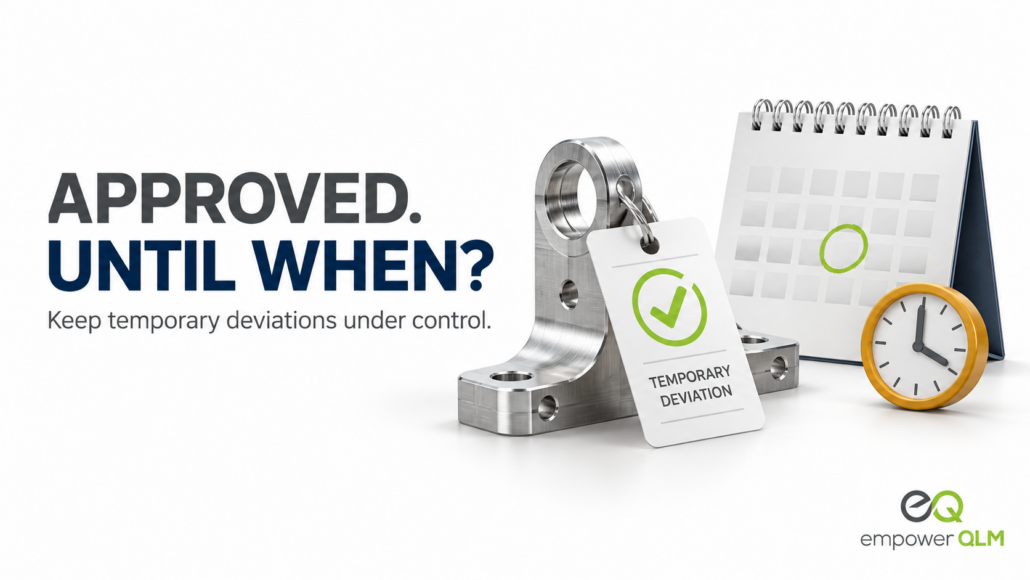
Your temporary deviation was approved. Who’s tracking when it ends?
A temporary deviation can keep production moving under approved conditions. Managing it means keeping those conditions visible until the exception ends.
Consider a supplier whose usual production fixture is being repaired. The supplier proposes an alternate fixture, submits supporting evidence, and receives the required authorization to use it for a defined period and quantity, with additional inspection.
Two weeks later, the repair is delayed. The original approval is still in an email thread. Production has a schedule to meet, purchasing is checking deliveries, and quality is waiting for an update.
Who knows how much of the authorized quantity remains? Who is responsible for requesting an extension? And what evidence will confirm that production has returned to the approved arrangement?
These are the questions that make temporary deviation management an ongoing responsibility.
Define the boundaries of the approval
A temporary deviation authorizes a specific departure from a requirement under defined conditions. Terminology and approval processes vary by customer and industry, so teams need to follow the procedure that applies to their product and relationship.
The distinction between internal agreement and customer authorization matters. In automotive manufacturing, for example, the IATF sanctioned interpretation of clause 8.7.1.1 addresses obtaining a customer concession or deviation permit before further processing when the product or manufacturing process differs from what is currently approved.
An effective deviation record should make the boundaries easy to understand:
● The requirement or approved condition being departed from.
● The affected part numbers, revisions, suppliers, and locations.
● The permitted date range, quantity, lots, or other limits.
● Any required inspection, identification, segregation, or reporting controls.
● The responsible owner and authorized approvers.
● The conditions and evidence needed to end the temporary arrangement.
A status of “approved” is useful only when the people acting on it can see what that approval covers.
Keep the conditions visible where work
happens
In the fixture example, engineering may understand the technical justification while production needs the operating instructions, and inspection needs the additional checks. Shipping may also need to identify affected lots according to the authorization.
Each team needs access to the same current decision, expressed in a way that supports its work.
A practical approach is to connect the deviation record to the relevant instructions, inspection requirements, and approval evidence. When conditions change, the owner should confirm that affected teams have received and implemented the update.
The question to ask is straightforward: could someone running the next shift tell whether this deviation still applies to the work in front of them?
Review the next decision before the limit is reached
An expiration date is a deadline for an authorized arrangement. It should also drive an earlier review, leaving time to gather evidence and obtain any required decision.
For a quantity-limited approval, the review also needs reliable information about how much of the authorized quantity has been used. A calendar reminder alone cannot answer that question.
Before the applicable limit is reached, the owner should coordinate one of three paths:
Return to the approved condition. Confirm that the original arrangement has been restored and that the required checks support its use.
Request an extension. Explain why more time or quantity is needed, review the latest evidence and risk, and obtain the required authorization before continuing beyond the existing limits.
Propose a permanent change. Evaluate the proposed condition through the applicable change-control and customer approval process, including any required updates to validation, documentation, or PPAP.
A pending extension request does not itself expand an approval. If authorization has lapsed, affected work and product need to be controlled through the applicable procedures while the responsible authority determines the next step.
Connect the deviation to PPAP and controlled documents
A temporary arrangement can affect the conditions represented by existing quality records. Teams should assess which records need review and how the temporary authorization relates to them.
For example, the alternate fixture may raise questions about process risk, inspection methods, work instructions, or evidence associated with the approved manufacturing process. The appropriate response depends on the change and the customer’s requirements.
A temporary deviation does not automatically require a complete PPAP resubmission. It does require a clear decision about applicable notification, evidence, and approval requirements.
Document control matters during both transitions: introducing the temporary arrangement and returning to normal production. Instructions that were valid during the deviation should not remain in active use after their authorization ends.
Close the deviation with evidence
Reaching an end date does not demonstrate that the original process has been restored.
Closure should establish what happened, when it happened, and which evidence supports the decision. Depending on the deviation, that may include verification of the restored equipment or process, inspection results, identification of the first conforming production lot, updated instructions, and disposition of remaining affected inventory.
In the fixture example, “repair complete” is only part of the answer. The team also needs to confirm that the fixture is ready for use, that applicable verification has been completed, and that production and inspection are working to the correct instructions.
Repeated extensions deserve attention as well. They can be a useful signal that the underlying issue needs a more durable resolution or a formal permanent-change review.
How Empower QLM supports change and deviation management
Empower QLM’s Change Management including Deviation Management module supports configurable templates and libraries across plants, approval workflows, and cross-functional risk assessments. Teams can submit their evaluations, with a visual risk meter presenting the resulting risk rating.
System-generated email notifications and reminders support assigned actions and status updates. Business intelligence integration enables user-specific dashboards, while linkage with PPAP Workflow Management helps connect change decisions to related approval activity.
Related document and inspection processes provide the controlled instructions, and evidence teams need to execute and review an authorized arrangement.
Together, these capabilities support a more consistent process for evaluating requests, coordinating responsibilities, and keeping decisions visible across the functions involved.
Make the exit plan part of the approval
A useful review of any open deviation begins with three questions: what is authorized, how much authorization remains, and what must happen before it ends?
When those answers are clear, teams can make the next decision with time to act.
Review one of your current deviation workflows with Empower QLM. Request a demo to see how configurable approvals, cross-functional risk assessments, reminders, and PPAP linkage can help your team manage temporary exceptions with clearer ownership and visibility.
Frequently Asked Questions
1. What is a temporary deviation in manufacturing?
It is an authorized, limited departure from a specified requirement or approved condition. The authorization defines its scope and conditions, which may include a date range, quantity, identified lots, or additional controls. The applicable customer procedure determines the terminology and approval requirements.
2. Does internal approval replace customer approval?
Only the applicable requirements determine who can authorize the departure. Where customer approval is required, internal agreement does not replace it. Teams should establish the approval authority before implementing the proposed deviation.
3. Does every temporary deviation require a new PPAP?
No. The required response depends on the nature of the departure, existing approval conditions, and customer requirements. Teams should assess whether notification, additional evidence, an updated submission, or another form of authorization is necessary.
4. What should happen if the deviation expires before the issue is resolved?
Teams should not assume the original approval continues. Control the affected activity and product under the applicable procedures, escalate to the responsible authority, and obtain any required extension or new approval before proceeding beyond the authorized conditions.
5. What evidence is needed to close a deviation?
The evidence should demonstrate that the authorized exit conditions have been met. Depending on the situation, this may include process verification, inspection results, updated instructions, lot identification, inventory disposition, and the required review or approval.
6. How can software support deviation management?
Software can help organize requests, route approvals, coordinate risk reviews, notify responsible people, and connect decisions with related quality records. Empower QLM supports these activities through its Change and Deviation Management capabilities and PPAP linkage.
About Us
RGBSI’s quality division and EmpowerQLM software address the COPQ problems covered in this article through a combined services and platform model. RGBSI supports manufacturers with COPQ baseline studies, supplier chargeback recovery programs, PPAP and APQP execution support, supplier development, audits, 8D problem solving, and warranty-related quality services. These services help manufacturers identify hidden cost categories, quantify supplier-driven losses, and establish defensible recovery mechanisms.
EmpowerQLM provides the workflow infrastructure to operationalize that model. NC Management captures nonconformances at the point of failure. CoPQ Management links cost fields, chargeback workflows, and recovery status to NCs, 8Ds, CAPAs, PPAPs, and warranty records. Warranty Management connects field claims to financial exposure and recurrence analysis. Supplier Scorecards bring quality cost into supplier performance discussions. ERP and finance-system integration support debit and credit note tracking, so quality cost can move from hidden overhead to attributable financial governance.
Together, RGBSI and EmpowerQLM help enterprise manufacturers make COPQ visible, recoverable, and preventable. More detail on the services side is available through EmpowerQLM Quality Management Services.
Download Empower QLM Software Overview Brochure