Closing the Gap Between Work Instructions and What Happens on the Shop Floor
A work instruction defines how a task should be performed. Layered process audits help teams verify whether critical steps are being followed and address the gaps they find.
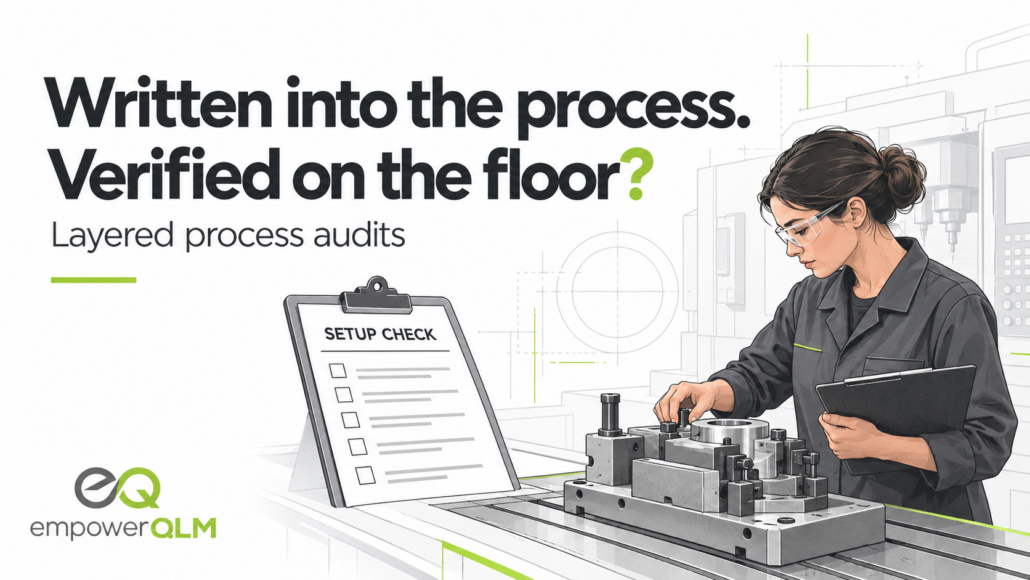
Consider a hypothetical assembly line where the work instruction requires a setup check after each changeover. The instruction is approved, available at the workstation, and included in operator training.
During an audit, the team cannot find the required record for the latest changeover. The operator believes the check was completed. The supervisor is unsure whether the record belongs with the setup sheet or the shift log.
That missing evidence does not prove the product is defective. It does leave a question that needs a response: was the required check performed, and what should happen while the team establishes the answer?
Check how the process is being carried out
AIAG describes layered process audits (LPAs) as brief process verifications involving different organizational levels, from team leaders through plant leadership. Their purpose is to give consistent attention to controls that matter to quality.
An LPA should connect the documented requirement to something the auditor can verify at the process. For the assembly line, that could mean confirming the applicable setup requirement, examining the relevant record, and observing a check when the activity occurs.
The evidence has limits. A record of an earlier check and an observation of a current one answer different questions. Neither establishes that every changeover on every shift was handled correctly.
Ask questions that lead to clear evidence
A question such as “Is the process being followed?” leaves too much room for interpretation.
A more useful question identifies the specific control and expected evidence. Depending on the approved process, examples might include:
● Is the setup setting within the range specified for the part currently running?
● Is the required verification record available for the latest changeover?
● Was the error-proofing check completed at the required interval, with the result recorded?
● Is the current approved work instruction available at the point of use?
These are examples to adapt, not a universal checklist. Define what constitutes acceptable evidence and how to record an activity that could not be observed.
AIAG’s guidance on effective LPA questions emphasizes objective, specific checks tied to relevant concerns. Reviewing questions after process changes or recurring findings helps keep the audit useful.
Make participation across layers meaningful
Layered participation gives people at different levels direct exposure to process conditions. It also brings attention to obstacles that a local team may struggle to resolve.
In the setup example, an auditor might discover that two forms request the same information or that the approved instruction is difficult to access during a changeover. Those observations deserve investigation before the organization concludes that more training will solve the problem.
Plan coverage across shifts and relevant operating conditions. If audits always take place during steady production, a problem associated with changeovers may remain difficult to see. Set frequencies and responsibilities around process risk, applicable customer requirements, and the organization’s audit approach.
Give each finding a defined response
When a required control cannot be verified, the auditor should record the specific gap and notify the responsible person through the established process. Any immediate response should follow the applicable reaction plan, including assessment of potentially affected product when warranted.
For the missing setup record, the team needs to establish what happened and whether there is other reliable evidence of the check. If the check was missed, completing it now does not establish the condition of earlier production.
Assign an owner and a due date for follow-up. Keep the immediate correction distinct from work needed to prevent recurrence. Repeated recordkeeping gaps may call for a clearer method, better access, or a broader investigation.
Closure should include evidence appropriate to the issue. A revised form or a completed training session shows that an action occurred. Follow-up verification helps determine whether the intended control is now being followed.
Review what the audits are revealing
Completion rates help show whether planned audits took place. Management also needs to understand recurring findings, overdue actions, coverage gaps, and whether earlier actions held up during later checks.
Repeated findings deserve attention even when the overall completion rate looks strong. Conversely, few findings are not automatically evidence of a sound process; review whether questions and observations are sufficiently focused.
AIAG’s CQI-8 overview connects LPAs with performance measures, management review, and evaluation of audit effectiveness. The practical objective is to use what audits reveal to improve how the process operates.
How Empower QLM supports layered process audits
Empower QLM’s LPA Audit Management with Mobile App supports the organization and follow-through this work requires.
Teams can configure audit layers, questions, scoring criteria, and mandatory questions. Frequencies can be set by layer, while audit planning, scheduling, and calendar tracking help coordinate participation.
Web and mobile applications support audit management. Findings and nonconformities can be managed through the module, with corrective and preventive action (CAPA) integration supporting issue resolution. Business intelligence integration enables user-specific dashboards.
These capabilities help teams organize the work around critical checks, findings, and follow-up. People still need to select meaningful questions, collect reliable evidence, and judge whether an action was effective.
To review your current approach, select one critical process check and follow it from the work instruction through the latest audit and any resulting action. Can your team reconstruct what was checked, what was found, and what changed afterward?
Explore Empower QLM’s audit capabilities and request a demonstration focused on your audit layers, scheduling, and findings-to-CAPA workflow.
Frequently Asked Questions
What is a layered process audit?
An LPA is a focused verification of important process requirements, performed by people at different organizational levels. It helps teams check execution and respond to identified gaps.
How does an LPA differ from product inspection?
Product inspection evaluates specified characteristics of a product. An LPA checks selected process requirements and controls. The two activities provide different evidence and can complement each other.
Who should participate in layered process audits?
Participation should extend beyond quality and include the relevant management layers. Define responsibilities so auditors understand the process, required evidence, and escalation route.
How often should layered process audits take place?
There is no single frequency suitable for every operation. Consider process risk, customer requirements, production patterns, and findings history when defining the schedule for each layer.
Does every LPA finding require an 8D?
No. The response should reflect the issue, risk, recurrence, and applicable requirements. Some findings need a local correction; others warrant structured corrective action or an eight disciplines (8D) investigation.
Can LPA software verify that a process is always followed?
Software can help organize audits, findings, and actions. Confidence still depends on meaningful checks, adequate coverage, reliable observations, and follow-through. An audit result has a defined scope.
About Us
RGBSI’s quality division and EmpowerQLM software address the COPQ problems covered in this article through a combined services and platform model. RGBSI supports manufacturers with COPQ baseline studies, supplier chargeback recovery programs, PPAP and APQP execution support, supplier development, audits, 8D problem solving, and warranty-related quality services. These services help manufacturers identify hidden cost categories, quantify supplier-driven losses, and establish defensible recovery mechanisms.
EmpowerQLM provides the workflow infrastructure to operationalize that model. NC Management captures nonconformances at the point of failure. CoPQ Management links cost fields, chargeback workflows, and recovery status to NCs, 8Ds, CAPAs, PPAPs, and warranty records. Warranty Management connects field claims to financial exposure and recurrence analysis. Supplier Scorecards bring quality cost into supplier performance discussions. ERP and finance-system integration support debit and credit note tracking, so quality cost can move from hidden overhead to attributable financial governance.
Together, RGBSI and EmpowerQLM help enterprise manufacturers make COPQ visible, recoverable, and preventable. More detail on the services side is available through EmpowerQLM Quality Management Services.
Download Empower QLM Software Overview Brochure