
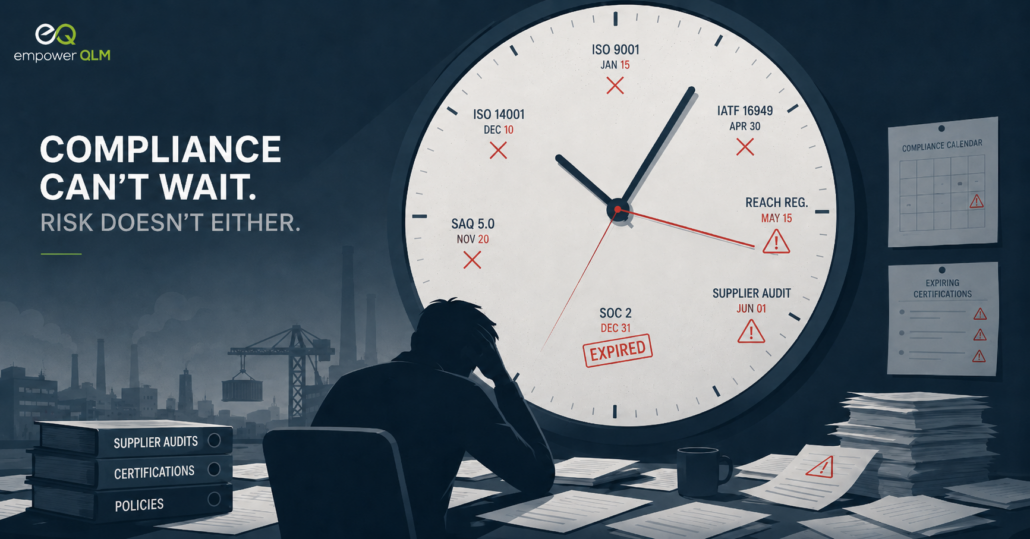
Your Supplier Certificates Are Expiring Faster Than Your Team Can Track Them
An expired supplier certificate rarely fails quietly.
It blocks a PPAP approval. It creates an audit finding. It delays supplier qualification. It exposes a program to a supplier whose quality, insurance, material compliance, or cybersecurity credentials are no longer valid.
The document may still exist in a folder. That does not mean the supplier is compliant.
The real operational problem is continuously determining:
● Which required certificates are missing
● Which certificates are approaching expiration
● Which certificates have already expired
● Whether the supplier submitted the correct document
● Whether the expiration date and critical information are valid
● Which suppliers, parts, programs, PPAPs, and approvals are affected
Most organizations try to answer these questions with spreadsheets, shared drives, email reminders, and manual reviews. That approach breaks down as the supplier base, certificate requirements, and number of active programs increase.
What Is Empower QLM Automated Supplier Certificate Management?
Empower QLM Automated Supplier Certificate Management is an AI/OCR-enabled QLM module that validates supplier certificates, monitors expiration risk, and automates renewal, review, and approval workflows across suppliers, parts, programs, and quality processes.
It gives procurement, quality, APQP, PPAP, engineering, and PLM teams one controlled view of supplier certificate status.
The module tracks critical documents such as:
● ISO 9001 certificates
● IATF 16949 certificates
● AS9100 certificates
● Insurance certificates
● Material compliance documents
● Cybersecurity certificates and compliance documents
Empower QLM goes beyond storing these files. It evaluates whether the submitted document is the expected certificate, extracts critical information using AI/OCR, monitors expiration dates, identifies gaps, and initiates the required supplier actions.
A Shared Folder Cannot Tell You What Is at Risk
A document repository can confirm that a file was uploaded.
It cannot reliably determine whether:
● The file is an ISO 9001 certificate or an unrelated document
● The certificate belongs to the correct supplier or facility
● The certificate is still valid
● The expiration date was entered correctly
● A replacement certificate is already overdue
● A pending PPAP depends on that certificate
● A supplier approval should be placed on hold
● Multiple parts or programs are exposed
That verification work usually falls to procurement coordinators, supplier quality engineers, APQP owners, and compliance teams.
They open files, inspect certificate types, enter dates into spreadsheets, send renewal emails, follow up with suppliers, review replacements, and update status reports. Every manual step creates another opportunity for delay or error.
Empower QLM turns that fragmented activity into a controlled digital process.
AI/OCR Validation Checks the Document, Not Just the Filename
Suppliers do not always upload the correct file. They may submit an outdated certificate, select the wrong document type, attach a certificate for another facility, or enter an incorrect expiration date.
Empower QLM uses AI/OCR-based document validation to read submitted certificates and verify critical information, including:
● Certificate type
● Expiration date
● Supplier information
● Facility or site information
● Other required data fields
The system can compare the document against the requested certificate requirement and route exceptions for review.
This reduces the risk of approving a supplier based on incorrect, outdated, or unverified information. It also reduces the time quality, and procurement teams spend manually opening and checking every submission.
Automated Expiration Monitoring Stops Silent Lapses
Certificate expiration should trigger action before it becomes a compliance failure.
Empower QLM continuously monitors certificate status and sends renewal reminders as expiration dates approach. Suppliers receive workflow-driven requests to submit updated documents, while internal teams receive visibility into outstanding actions and escalating risk.
A certificate-status dashboard can clearly separate:
● Valid: Certificate reviewed and currently active
● Expiring Soon: Renewal required before the defined deadline
● Expired: Certificate validity has lapsed
● Missing: Required certificate has not been received
● Pending Review: Supplier submission requires internal verification
● Incorrect Document: Submission does not match the requested certificate
● Not Submitted: Supplier has not responded to the request
Procurement no longer needs to search through spreadsheets to identify exposed suppliers. Quality no longer discovers an expired certificate during a PPAP review or audit. Engineering no longer has to guess whether an approved supplier remains qualified for a specific program.
Certificate Status Must Be Connected to PPAP and APQP
A supplier certificate does not exist in isolation.
An expired IATF 16949 certificate may affect automotive sourcing eligibility. An expired AS9100 certificate may create aerospace supplier qualification risk. Missing material compliance documentation may prevent PPAP approval. An expired insurance certificate may violate contractual sourcing requirements. Missing cybersecurity documentation may expose supplier onboarding or connected-product programs.
Empower QLM connects certificate status to the broader quality lifecycle.
Certificate information can support:
● Supplier onboarding and approval
● Supplier risk assessment
● Supplier KPI and scorecard evaluation
● APQP program management
● PPAP submission and approval
● Material compliance processes
● Cybersecurity compliance
● Integrated eRFI and eRFQ decisions
● BOM and part-level traceability
● Audit preparation and evidence
● Business intelligence dashboards
This connection matters because leaders need to understand impact, not simply document status.
A procurement leader needs to know which suppliers are no longer qualified.
An APQP or launch manager needs to know which PPAPs may be blocked.
An engineering or PLM leader needs to know which parts and programs depend on the affected supplier.
A quality leader needs to know whether the lapse creates an audit or compliance exposure.
Empower QLM brings those answers into one QLM environment.
Replace Certificate Chasing with Supplier Workflows
Spreadsheet-based certificate management requires internal employees to drive every step manually.
They identify upcoming expirations, contact suppliers, resend requests, inspect documents, enter new dates, obtain approvals, and update reports. When ownership changes or workload increases, renewals are missed.
Empower QLM replaces this process with configurable supplier workflows.
The system can:
1. Request the required certificate from the supplier.
2. Provide secure supplier access for document submission.
3. use AI/OCR to extract and validate critical information.
4. Route the submission through review and approval.
5. Monitor the approved certificate’s expiration date.
6. Send renewal reminders before expiration.
7. Escalate missing, incorrect, or overdue submissions.
8. Update supplier, part, program, PPAP, and risk visibility.
The result is a repeatable process that does not depend on personal calendars, email folders, or spreadsheet discipline.
Give Every Function the Visibility It Needs
EmpowerQLM provides one certificate control layer while giving each team relevant visibility.
Procurement and supply chain leaders can identify suppliers with missing, expired, or unverified credentials before making sourcing and qualification decisions.
Quality, APQP, and PPAP leaders can see certificate-related approval risks before they delay a launch or create an audit finding.
Engineering and PLM leaders can connect supplier compliance status to affected parts, product structures, programs, and approvals.
Executives can use BI dashboards to monitor certificate health, supplier exposure, renewal performance, and compliance trends across the enterprise.
The organization moves from reactive certificate chasing to controlled supplier compliance management.
Stop Finding Expired Certificates During Audits and Launch Reviews
A supplier certificate problem should be identified when the risk first appears, not when an auditor, customer, or launch team discovers it.
Empower QLM Automated Supplier Certificate Management continuously validates certificate submissions, monitors expiration dates, automates supplier renewals, and connects compliance status to the wider quality lifecycle.
See the supplier certificate dashboard in action and learn how Empower QLM can replace spreadsheet-driven certificate tracking across your supply base.
What does automate supplier certificate management software do?
Automated supplier certificate management software collects, validates, monitors, and renews supplier certificates through controlled digital workflows. It identifies missing, expired, incorrect, and unverified certificates and shows which suppliers, parts, programs, and approvals are affected. Empower QLM provides this control within an integrated quality lifecycle management platform.
How do you track supplier certificate expiration across a large supply base?
Supplier certificate expiration is tracked by recording validated expiration dates, continuously monitoring certificate status, sending advance renewal reminders, and escalating overdue supplier actions. This replaces manual spreadsheet reviews and individual calendar reminders.
Empower QLM automates expiration monitoring across suppliers, facilities, certificate types, parts, and programs.
How does AI and OCR validate supplier certificates?
AI and OCR read the submitted certificate and extract critical fields such as certificate type, expiration date, supplier name, facility information, and other required data. The extracted information can be compared with the requested certificate requirement so incorrect or inconsistent submissions are routed for review. Empower QLM uses AI/OCR validation to prevent unverified documents from being treated as approved certificates.
What happens when a supplier certificate expires during a PPAP?
An expired supplier certificate can place the PPAP on hold, invalidate a required approval condition, create an audit finding, or require the supplier to complete renewal before approval proceeds. The impact depends on the certificate type, customer requirements, and configured quality workflow. Empower QLM flags the expiration and connects the risk to the affected supplier, part, PPAP, and program.
Can supplier certificate status be connected to APQP programs and part approvals?
Supplier certificate status can be linked to APQP programs, PPAP packages, part approvals, supplier qualification, material compliance, audits, and BOM-level traceability. This allows teams to see where a missing or expired certificate creates downstream approval risk. Empower QLM connects certificate control to the broader APQP, PPAP, supplier management, compliance, and PLM environment.
Why is spreadsheet-based supplier certificate tracking risky?
Spreadsheet-based tracking depends on manual data entry, individual ownership, periodic reviews, and employees remembering to contact suppliers before expiration. It cannot reliably validate uploaded documents or automatically show how a certificate lapse affects parts, PPAPs, programs, and approvals. Empower QLM replaces spreadsheet dependency with automated monitoring, supplier workflows, AI/OCR validation, and centralized risk visibility.
Which supplier certificates can Empower QLM track?
Empower QLM can track quality, insurance, regulatory, material, and cybersecurity documents, including ISO 9001, IATF 16949, AS9100, insurance certificates, material compliance documentation, and cybersecurity certificates. Certificate types and requirements can be configured around the organization’s suppliers, industries, plants, and approval processes. Empower QLM manages these requirements through one controlled supplier certificate workflow.
How does supplier certificate management reduce audit and launch risk?
Supplier certificate management reduces audit and launches risk by identifying missing, incorrect, and expiring documents before they block an approval or create a compliance gap. Automated reminders and escalation workflows give suppliers and internal owners time to correct the issue before the deadline. Empower QLM provides early warning and connects certificate risk directly to supplier approvals, audits, APQP programs, and PPAP decisions.
About Us
RGBSI’s quality division and EmpowerQLM software address the COPQ problems covered in this article through a combined services and platform model. RGBSI supports manufacturers with COPQ baseline studies, supplier chargeback recovery programs, PPAP and APQP execution support, supplier development, audits, 8D problem solving, and warranty-related quality services. These services help manufacturers identify hidden cost categories, quantify supplier-driven losses, and establish defensible recovery mechanisms.
EmpowerQLM provides the workflow infrastructure to operationalize that model. NC Management captures nonconformances at the point of failure. CoPQ Management links cost fields, chargeback workflows, and recovery status to NCs, 8Ds, CAPAs, PPAPs, and warranty records. Warranty Management connects field claims to financial exposure and recurrence analysis. Supplier Scorecards bring quality cost into supplier performance discussions. ERP and finance-system integration support debit and credit note tracking, so quality cost can move from hidden overhead to attributable financial governance.
Together, RGBSI and EmpowerQLM help enterprise manufacturers make COPQ visible, recoverable, and preventable. More detail on the services side is available through EmpowerQLM Quality Management Services.
Download Empower QLM Software Overview Brochure