
Why Managing PPAP and Material Compliance Separately Creates Approval Delays
A Complete PPAP Can Still Be Unapprovable
A supplier submits the dimensional results, capability studies, control plans, and PSW for the current part, but the PPAP still cannot be approved because the IMDS declaration in a shared folder belongs to the previous revision.
The failure is not a lack of effort. It is a process design flaw. Quality reviews the PPAP while Compliance and Procurement pursue declarations in a separate workflow, with no shared status confirming that every approval condition has been met.
A spreadsheet can show a missing declaration, and a shared drive can store the PDF. Neither can consistently connect the evidence to the correct part revision, route it through review, and prevent PPAP approval until the requirement is satisfied. Tracking identifies a gap.
Gating controls the decision. Dimensional and process evidence shows that the part meets specification. It does not prove that its material or substance content meets IMDS, REACH, RoHS, PFAS, Prop 65, or conflict minerals requirements. When those declarations are required, technical completeness does not equal approval eligibility.
Parallel PPAP and Compliance Workflows Break Approval Control
Separate workflows create separate versions of readiness. The PPAP engineer sees submitted elements. The compliance lead sees open declarations. Procurement sees unanswered supplier emails. The supplier sees several requests and may not know what blocks approval.
It gives procurement, quality, APQP, PPAP, engineering, and PLM teams one controlled view of supplier certificate status.
The breakdown usually appears as:
● Different owners and trackers
● Manual supplier follow-up
● Unclear submission requirements
● Missing or outdated declarations
● Reviews tied to the wrong revision
● No shared approval status
Requirements also vary by customer, region, commodity, and standard. Teams compensate with spreadsheets, email chains, and local knowledge. That structure breaks when ownership
changes, volume increases, or an auditor asks for the approval history.
Most organizations already track compliance. But tracking is not gating. Tracking tells the team what is missing after someone checks. Gating prevents approval until the required evidence has been submitted, reviewed, and accepted.
Late Compliance Gaps Delay Launches and Weaken Audit Readiness
A compliance gap found early is a supplier action. The same gap found during final PPAP review becomes a program problem. Quality reopens the submission, Compliance requests corrected evidence, Procurement escalates the supplier, and Engineering confirms whether the declaration matches the released revision.
Late discovery can lead to:
● PPAP resubmission cycles
● Launch and milestone delays
● Sourcing disruption
● Engineering and SQE rework
● Rejected customer submissions
● Regulatory and audit exposure
Scattered evidence also weakens the audit trail. The organization must show what was required, what was submitted, who reviewed it, which revision it covered, and why the PPAP was approved. When those answers live across email, spreadsheets, and folders, reconstructing the decision becomes separate work.
Program timing suffers too. A due date in one tracker does not control a milestone in another. A compliance task can remain open while the PPAP timeline continues to show apparent progress.
Material Compliance Must Be a PPAP Approval Condition
Where material compliance is required, it belongs inside the PPAP approval gate. It should be managed with the same discipline as a control plan or PSW, not treated as supporting paperwork checked near the end.
Each part-level requirement needs:
● A defined compliance deliverable
● An assigned supplier or internal owner
● A due date tied to the PPAP timeline
● A documented review step
● An approval or rejection status
● A gate that blocks final approval
This changes the question from “Did we receive a file?” to “Has the required compliance condition been satisfied for this part and revision?” A declaration sitting in a folder is a document. The same declaration linked to a part revision, owner, reviewer, due date, and approval gate is a control.
Rejected, outdated, or incorrectly linked evidence must remain an open condition until it is resolved. It should never look like completion simply because a file exists.
Compliance Evidence Must Connect to the Part, Supplier, Revision, Program, and BOM
Material compliance evidence has little operational value as an isolated PDF. The record must show what it applies to and where a change creates impact.
The traceability chain should connect:
● Supplier
● Part number
● Part revision
● PPAP submission package
● Program
● BOM
These links distinguish a valid declaration from a merely available declaration. A supplier may submit the correct form for an earlier revision. A review may be approved for a different part family. One component may be complete while another item in the BOM remains unresolved.
Connected records also improve change response. When a part, supplier, revision, or requirement changes, Quality and Compliance can see which PPAPs, products, and programs require review.
Empower QLM Turns Compliance Documents Into Approval Control
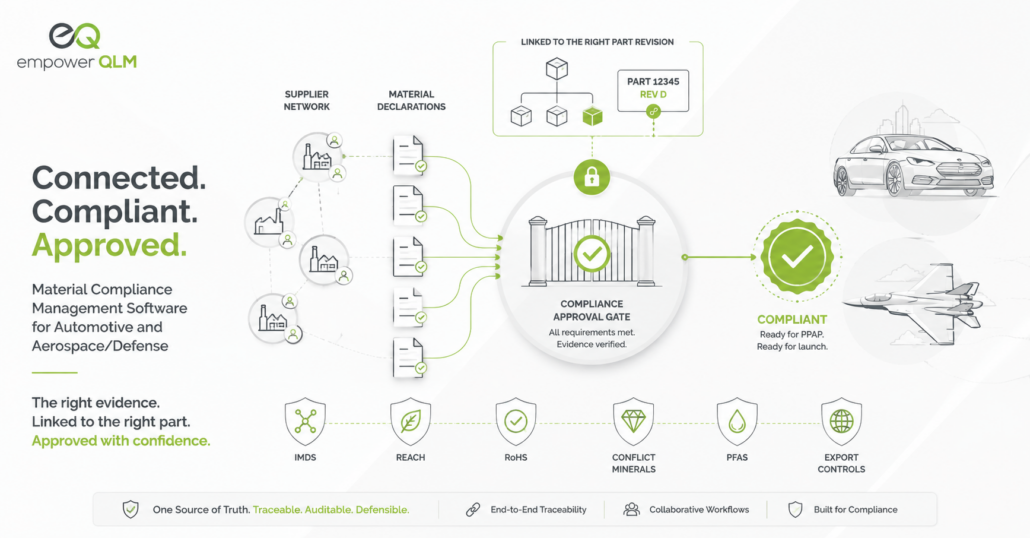
Empower QLM’s Material Compliance module enforces this model through a connected workflow. Configurable templates define the requirements for the relevant part and business context. Supplier and internal workflows collect the information and route it for review. Chemical analysis supports evaluation of hazardous substances against defined requirements. Automated reminders keep open actions visible. Reporting shows status, while direct integration with PPAP Management ensures required compliance conditions are met before PPAP approval is granted.
The value comes from the chain. Supplier submissions feed internal reviews. Reviews produce an approval status. That status feeds reporting and the PPAP decision. Compliance no longer sits beside PPAP as a parallel checklist. It becomes one of the conditions the PPAP gate evaluates.
This structure reduces the time engineers and SQEs spend checking trackers, searching for attachments, and asking whether Compliance approved the latest submission. It gives suppliers clearer requirements and due dates, gives reviewers a controlled workflow, and gives quality leaders one answer: is this part actually ready for approval?
The outcomes are faster PPAP coordination, stronger supplier accountability, better launch readiness, lower program risk, and cleaner audit preparation. They come from preventing approval from getting ahead of its evidence.
PPAP Approval Depends on Part-Level Compliance Control
A supplier submits the dimensional results, capability studies, control plans, and PSW for the current part, but the PPAP still cannot be approved because the IMDS declaration in a shared folder belongs to the previous revision.
Supplier certificates confirm that the supplier is qualified and current. Material compliance confirms that the actual part is compliant and approvable. The adjacent question is then explicit: when a supplier, part, revision, or declaration changes, which products and programs are affected? BOM traceability provides that next layer of control.
Request a demonstration to see how Empower QLM connects material compliance status directly to PPAP approval decisions.
Frequently Asked Questions
Is material compliance required for PPAP?
Material compliance is required as part of PPAP when applicable customer-specific requirements, engineering specifications, contractual requirements, or laws and regulations make it an approval condition. In those cases, an otherwise complete PPAP cannot receive full approval until the required compliance evidence has been accepted or the customer has authorized an interim approval or deviation.
Can a PPAP be complete without an accepted IMDS submission?
Yes, if the customer does not require an IMDS submission for that part or program. When IMDS is required, however, the PPAP generally cannot receive full approval until the material data sheet has been accepted and corresponds to the correct part and current material information. A missing, rejected, outdated, or incorrectly associated submission should be treated as an open PPAP approval condition rather than a separate follow-up item.
How should PFAS and REACH requirements be handled in PPAP?
When PFAS or REACH requirements apply, they should be defined as specific compliance deliverables at the appropriate part, material, or BOM level. Each requirement should have an assigned supplier or internal owner, defined evidence, due dates, and a controlled review process. The required declarations, test reports, or substance data will vary by customer, product, market, and applicable legal obligation, so the workflow must be configurable.
Why is spreadsheet tracking not enough for material compliance?
Spreadsheets can support low-volume tracking, but they become fragile as the number of parts, suppliers, revisions, regulations, and reviewers grows. They do not inherently control the relationships among the requirement, supplier submission, part revision, reviewer, due date, approval decision, and PPAP package. A dedicated material compliance system provides workflow, traceability, notifications, access control, and approval gating rather than simply recording a status.
What happens when compliance evidence is rejected during PPAP review?
The compliance requirement should remain open, and full PPAP approval should be withheld until corrected evidence is submitted and accepted. The PPAP may proceed only when the customer grants an authorized interim approval, waiver, or deviation. The rejection reason, supplier response, revised evidence, reviewer decision, and final status should remain linked to the same part, revision, and PPAP package.
How does material compliance gating improve audit readiness?
Material compliance gating creates a traceable review history showing what was required, what evidence was submitted, which part and revision it applied to, who reviewed it, and whether the requirement was satisfied before approval. This makes the PPAP decision easier to reconstruct and defend during customer, regulatory, or quality-system audits.
How does Empower QLM integrate material compliance with PPAP?
Empower QLM connects configurable compliance requirements, supplier and internal workflows, chemical analysis, reminders, and reporting directly with PPAP Management. When compliance is configured as an approval gate, unresolved requirements remain visible within the PPAP process and can prevent full approval until the required evidence is accepted. This replaces a disconnected spreadsheet check with a controlled, traceable approval process.
About Us
RGBSI’s quality division and EmpowerQLM software address the COPQ problems covered in this article through a combined services and platform model. RGBSI supports manufacturers with COPQ baseline studies, supplier chargeback recovery programs, PPAP and APQP execution support, supplier development, audits, 8D problem solving, and warranty-related quality services. These services help manufacturers identify hidden cost categories, quantify supplier-driven losses, and establish defensible recovery mechanisms.
EmpowerQLM provides the workflow infrastructure to operationalize that model. NC Management captures nonconformances at the point of failure. CoPQ Management links cost fields, chargeback workflows, and recovery status to NCs, 8Ds, CAPAs, PPAPs, and warranty records. Warranty Management connects field claims to financial exposure and recurrence analysis. Supplier Scorecards bring quality cost into supplier performance discussions. ERP and finance-system integration support debit and credit note tracking, so quality cost can move from hidden overhead to attributable financial governance.
Together, RGBSI and EmpowerQLM help enterprise manufacturers make COPQ visible, recoverable, and preventable. More detail on the services side is available through EmpowerQLM Quality Management Services.
Download Empower QLM Software Overview Brochure