
PPWR Obligations for Manufacturers: What the EU Packaging Regulation Requires
The EU Packaging and Packaging Waste Regulation changes packaging compliance from a largely national exercise into a harmonized product compliance discipline. Manufacturers need defensible packaging data, documented assessments, supplier evidence, and clear ownership across the product lifecycle.
Quick answer: PPWR generally applies from August 12, 2026. Manufacturers should already be mapping packaging, confirming their legal roles, collecting supplier data, and preparing technical documentation.
What Is PPWR?
The Packaging and Packaging Waste Regulation, or PPWR, is Regulation (EU) 2025/40. It covers all packaging and packaging waste placed on the EU market, regardless of material or origin. It entered into force on February 11, 2025, and generally applies from August 12, 2026, although many detailed requirements begin later or depend on implementing and delegated acts.
Unlike the former directive, the regulation applies directly across EU Member States. Its requirements address packaging design, substances, recyclability, recycled content, minimization, labeling, reuse, conformity, and extended producer responsibility.
The official text is available through EUR-Lex, and the European Commission packaging and waste overview provides additional policy context.
Why PPWR Matters Now
The first major application date has arrived. From August 12, 2026, manufacturers must be able to show that applicable packaging requirements have been addressed.
Waiting for every secondary measure before organizing data creates avoidable risk. Packaging portfolios, supplier declarations, specifications, and assessment methods take time to standardize.
The practical shift is significant. Packaging decisions can no longer sit only with design, procurement, or sustainability teams. Quality and compliance functions need a traceable record showing what the package contains, why it was designed that way, which requirements apply, and what evidence supports the conclusion.
Core PPWR Obligations for Manufacturers
1. Assess Packaging Conformity
Before placing packaging on the EU market, manufacturers must perform the applicable conformity assessment. They must prepare the technical documentation described in Annex VII and, once conformity has been demonstrated, draw up the EU declaration of conformity required by Article 39 and Annex VIII.
The documentation should explain the packaging design, applicable requirements, assessment methods, supporting standards or specifications, test results, and other evidence.
Manufacturers must keep the technical documentation and declaration for five years after single-use packaging is placed on the market and for ten years after reusable packaging is placed on the market.
2. Control Substances and Material Composition
Packaging must meet PPWR substance restrictions and other applicable EU chemical rules.
From August 12, 2026, food-contact packaging may not be placed on the market when per- and polyfluoroalkyl substances, or PFAS, exceed the regulation’s thresholds. Reliable material declarations and supplier evidence are therefore essential.
3. Prepare for Recyclability Requirements
Packaging must be designed for material recycling.
Most packaging will need to satisfy recyclability performance grades from 2030, subject to listed exemptions and the timing of delegated acts. From 2035, recyclable packaging must also be recycled at scale, again subject to the regulation’s timing provisions.
Companies should treat these dates as design gates, not documentation deadlines.
4. Meet Recycled-Content Rules Where Applicable
The regulation sets minimum recycled-content percentages for certain plastic packaging from 2030, with higher mandatory targets for 2040.
Requirements vary by packaging category, and exemptions apply. Manufacturers need trustworthy input data and repeatable calculations that can be traced to supporting evidence.
5. Minimize Packaging and Empty Space
By January 1, 2030, packaging must be designed so its weight and volume are reduced to the minimum necessary while preserving functionality.
Product-presentation and marketing considerations may form part of the minimization assessment, but they cannot justify packaging features intended solely to increase perceived product volume or circumvent PPWR minimization requirements.
For grouped, transport, and e-commerce packaging, the empty-space ratio may not exceed 50 percent from January 1, 2030. Companies should document the functional reasons for packaging dimensions and protective features.
6. Address Labeling, Identification, and Traceability
Harmonized packaging labels are scheduled to apply from August 12, 2028, or later where the regulation ties application to implementing acts and transition periods.
Manufacturers must also identify themselves and provide contact information on the packaging or accompanying documentation, assign an identifying element such as a type, batch, or serial number, and ensure packaging remains traceable.
7. Take Corrective Action When Packaging Is Noncompliant
A manufacturer that believes packaging is not compliant must take the corrective measures needed to bring it into conformity, withdraw it, or recall it as appropriate.
When the packaging presents a risk, the manufacturer must promptly inform the competent national authorities and cooperate with them, including by supplying the information and documentation needed to demonstrate conformity.
Manufacturer and Producer Are Not Always the Same Role
PPWR uses several defined economic-operator roles. A company may be a manufacturer for product-compliance purposes and also a producer for extended producer responsibility, but the terms are not interchangeable.
A producer generally has registration and EPR duties in each Member State where it first makes packaging or packaged products available, based on the regulation’s role and market rules.
Organizations should complete a role assessment for each sales model and Member State. Importers, distributors, authorized representatives, fulfillment service providers, and online platforms may also have distinct duties.
Role mapping should precede the assignment of tasks in a compliance system.
A Practical PPWR Readiness Plan
A focused readiness program can begin with six actions:
● Build a packaging inventory by product, packaging level, material, component, supplier, and destination market.
● Map manufacturer, importer, distributor, and producer roles for each route to market.
● Identify evidence gaps for material composition, PFAS, recycled content, recyclability, dimensions, and reuse claims.
● Create a controlled method for Annex VII technical documentation and declarations of conformity.
● Prioritize redesign work against the 2030 recyclability, recycled-content, minimization, and empty-space requirements.
● Monitor delegated and implementing acts because some detailed methods, formats, and application dates remain conditional.
How Empower QLM Can Support PPWR Readiness
PPWR compliance depends on connected data and controlled workflows.
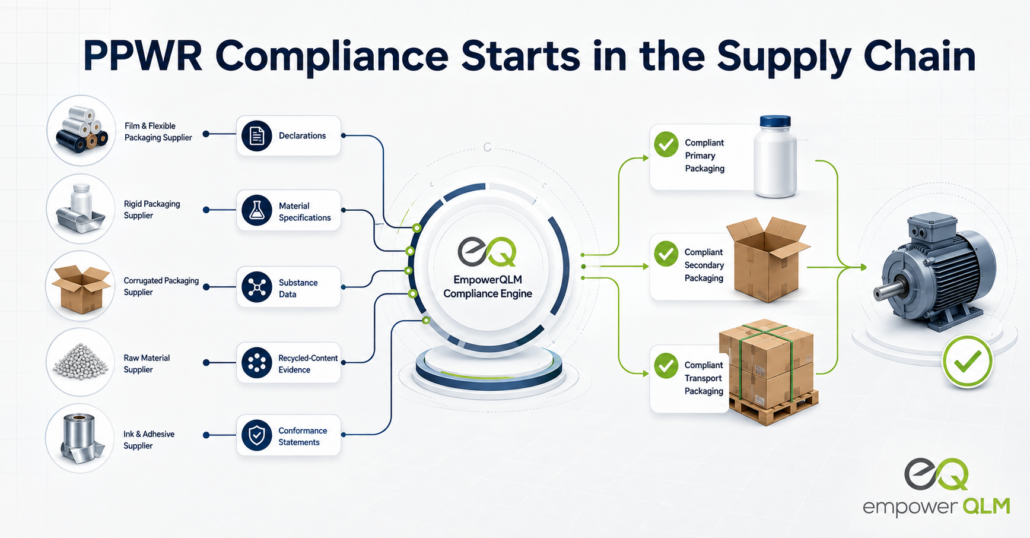
Empower QLM’s Packaging Regulation Management capabilities are designed to centralize regulatory requirements and packaging material information, manage regulation libraries and checklists, and support assessments for recyclability, recycled content, and material compliance.
Teams can configure calculations supporting recyclability and recycled-content assessments, track gaps and actions through dashboards, retain supplier declarations and compliance evidence, and coordinate supplier responses across products and sites.
This gives quality, compliance, engineering, procurement, and sustainability teams a shared record instead of a collection of spreadsheets and email attachments.
Ready to turn PPWR requirements into an auditable workflow? Explore Empower QLM and discuss how packaging compliance can fit into your quality management environment.
About Empower QLM
Empower QLM is an enterprise quality lifecycle management platform from RGBSI. It connects quality processes, compliance data, supplier collaboration, and operational insight in a configurable environment designed to support complex global organizations.
This article provides general information and is not legal advice. Organizations should evaluate PPWR obligations for their products, roles, markets, and supply chains with qualified legal and technical advisors.
Download Empower QLM Software Overview Brochure