
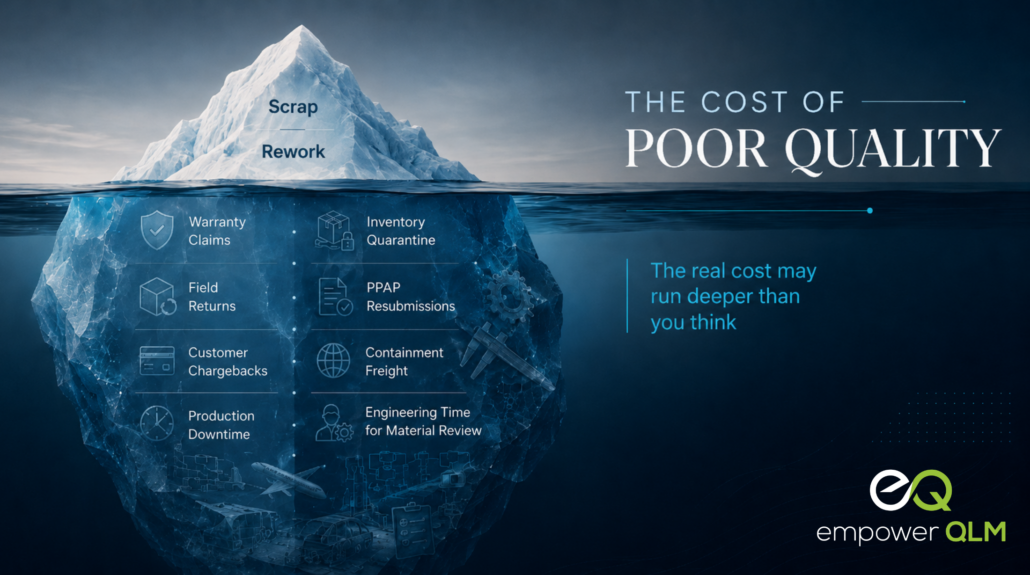
The True Cost of Poor Quality is Usually Larger Than Reported
Most COPQ programs undercount internal failures, supplier-driven losses, warranty exposure, and PPAP launch costs. For enterprise manufacturers, the problem is not only measurement. It is the missing connection between quality events, supplier recovery workflows, and finance systems.
Cost of Poor Quality is often discussed as a percentage of revenue, with widely cited quality-cost benchmarks using a 5% to 30% range as a signal of how material the exposure can become. The ASQ Cost of Quality framework defines quality cost as the resources used to prevent poor quality, appraise quality, and respond to internal and external failures. Juran’s formulation is even more direct: COPQ consists of costs that would disappear if there were no deficiencies, errors, rework, or failures.
That definition matters because many costs never surface as quality losses. Scrap, warranty claims, and debit memos are visible. Engineering disposition time, production holds,
containment freight, repeated PPAP submissions, and unrecovered supplier chargebacks often disappear into overhead, variance accounts, or project delay.
Under IATF 16949, PPAP-heavy supplier networks, and customer-specific requirements, underreported COPQ is a financial governance failure. It distorts supplier performance,
weakens cost recovery and makes quality investment look discretionary.
Why COPQ Is Underreported in Enterprise Manufacturing
COPQ is underreported because quality events and financial records live in different systems. Quality teams document nonconformances, SCARs, 8Ds, CAPAs, PPAP rejections, and warranty investigations in QMS workflows. Finance teams capture spends in ERP, accounts payable, inventory, labor, and variance accounts. Unless those records are connected, costs appear as operating noise instead of attributable quality failures.
This disconnect creates three problems. Internal failure costs are diluted into plant overhead. Supplier-driven costs are rarely converted into recoverable claims. Leadership sees cost of quality as a lagging metric, not as a decision system for supplier management, launch governance, and capital allocation.
What Counts as the True Cost of Poor Quality?
A complete COPQ model separates quality cost into four buckets: prevention, appraisal, internal failure, and external failure. Most mature manufacturers can account for prevention and appraisal with reasonable discipline. Training, audits, inspection, supplier qualification, quality planning, and measurement activity usually have owners, budgets, and recurring spend categories.
Internal failure costs include scrap, rework, re-inspection, sorting, production downtime, inventory quarantine, quality-hold storage, and engineering time spent on material review or deviation disposition. In automotive, a single nonconforming lot may require containment teams, added inspection, line changes, alternate sourcing, and customer communication long before it becomes a formal financial claim.
External failure costs include warranty claims, field returns, customer complaints, customer-imposed chargebacks, recall support, expedited replacement parts, and the administrative burden of SCARs and customer corrective action responses. OEM-imposed chargebacks for line stoppages, PPM exceedances, or missed launch commitments can reach five or six figures per incident. In aerospace and defense, AS9100 traceability requirements, customer notification, audit response, DCSA-related exposure, and contract risk raises external failure cost.
Supplier-Driven COPQ Is Often a Recovery Process Gap
Supplier-related quality cost is one of the most underreported COPQ categories. When a supplier ships nonconforming material, the receiving manufacturer may pay for incoming inspection, sorting, rework, engineering review, premium freight, production rescheduling, and customer containment. Many of those costs are real, measurable, and recoverable. Yet they are often never converted into a formal chargeback.
The failure point is usually workflow design. If the nonconformance record does not trigger cost capture, the disposition team may close the quality event without documenting labor, scrap value, sorting hours, premium freight, or downtime. If the SCAR does not carry that cost data forward, the supplier has little basis to accept recovery. If the supplier scorecard tracks PPM and delivery but not recoverable quality cost, procurement loses negotiating leverage during sourcing and business reviews.
A disciplined chargeback workflow should tie the NC, SCAR, cost evidence, supplier response, debit note, credit note, and recovery status into one auditable chain. That chain turns a quality incident into a financial recovery mechanism.
PPAP Failures Belong in the COPQ Ledger
PPAP failures are often treated as launch administration, but late or failed PPAP submissions create measurable quality cost. Engineering change delays, tooling re-qualification, extra dimensional layouts, repeated capability studies, customer-imposed resubmission fees, and launch readiness meetings consume real resources.
When PPAP is managed as disconnected document review, leaders often see only the delay. They do not see the cost of repeated submission cycles by supplier, element, part family, or program.
A stronger model treats PPAP as a risk and cost control system. That means linking PPAP rejection reasons to APQP risks, NC history, supplier scorecards, and financial impact. For a deeper view of PPAP as a strategic risk-control mechanism, see PPAP Management at Scale. The same logic applies upstream, where digital APQP governance prevents launch risk from being hidden inside status meetings and manual trackers, a problem examined in Why APQP Fails at Scale.
Connecting NCs, Warranty, PPAPs, and ERP to Finance
True COPQ capture starts at the point of failure. When an NC is opened, the workflow should prompt the responsible team to capture relevant cost fields: labor hours, scrap value, rework cost, inspection cost, downtime, containment spend, freight, customer chargeback amount, and supplier responsibility.
That cost record should then travel with the quality event. If the issue becomes an 8D or CAPA, the financial exposure remains attached. If it becomes a SCAR, supplier recovery is documented. If it becomes a warranty claim, the cost of review, repair, replacement, and recurrence prevention can be analyzed by product line, customer, defect mode, or supplier.
This is where QMS and ERP integration changes the operating model. The ERP remains the system of record for financial transactions. The QMS becomes the system of record for causal attribution. Together, they answer the leadership question: which quality failures created which costs, and which costs can be prevented or recovered?
EmpowerQLM’s module structure is aligned to this operating problem through NC Management, CoPQ Management, Warranty Management, PPAP Management, Supplier Scorecards, 8D, and CAPA workflows. In this model, supplier chargeback evidence is not reconstructed after a dispute. It is collected as the quality event unfolds.
Automated COPQ Capture Creates CFO-Level Quality Governance
Automated COPQ capture turns quality from a defect-counting function into a financial governance system. It allows leaders to view quality cost by supplier, part family, plant, commodity, program, customer, and failure mode. That visibility changes the executive conversation.
Instead of asking whether quality needs more resources, leadership can ask which suppliers create the highest unrecovered quality cost, which PPAP elements drive the most launch delay, which programs carry warranty exposure, and which recurrence problems are consuming engineering capacity. A recurring defect with low PPM but high downtime cost may deserve more attention than a higher-volume issue with limited financial exposure.
CAPA governance also becomes financially meaningful. A CAPA that closes the root cause should reduce future COPQ. If it does not, the recurrence signal may be disconnected from the cost signal, a problem explored in Why Most CAPA Systems Don’t Actually Prevent Recurrence.
The Executive Standard for COPQ Measurement
A mature COPQ program should answer five questions without spreadsheet reconstruction: what the failure cost internally, what the customer charged externally, which supplier or PPAP element created the cost, how much is recoverable or written off, and what corrective action prevents recurrence.
These are not accounting questions alone. They are quality, supplier management, program management, and finance questions. COPQ cannot be owned by quality in isolation. It needs a common operating model across quality, finance, procurement, manufacturing, engineering, and warranty.
The best COPQ systems do not chase a perfect estimate after the fact. They capture cost when the failure is still fresh, when evidence exists, and when supplier accountability can still be established. That is how manufacturers move from reporting poor quality to governing it.
About Us
RGBSI’s quality division and EmpowerQLM software address the COPQ problems covered in this article through a combined services and platform model. RGBSI supports manufacturers with COPQ baseline studies, supplier chargeback recovery programs, PPAP and APQP execution support, supplier development, audits, 8D problem solving, and warranty-related quality services. These services help manufacturers identify hidden cost categories, quantify supplier-driven losses, and establish defensible recovery mechanisms.
EmpowerQLM provides the workflow infrastructure to operationalize that model. NC Management captures nonconformances at the point of failure. CoPQ Management links cost fields, chargeback workflows, and recovery status to NCs, 8Ds, CAPAs, PPAPs, and warranty records. Warranty Management connects field claims to financial exposure and recurrence analysis. Supplier Scorecards bring quality cost into supplier performance discussions. ERP and finance-system integration support debit and credit note tracking, so quality cost can move from hidden overhead to attributable financial governance.
Together, RGBSI and EmpowerQLM help enterprise manufacturers make COPQ visible, recoverable, and preventable. More detail on the services side is available through EmpowerQLM Quality Management Services.
Download Empower QLM Software Overview Brochure