
Why Onsite-Only Supplier Audits Break Down at Enterprise Scale
A market research perspective on why OEMs and Tier 1s are moving toward hybrid supplier oversight
TL;DR
Onsite supplier audits still matter, but an onsite-only model does not scale across a large, globally distributed supplier base. At enterprise scale, it creates predictable failure modes: uneven coverage, inconsistent audit depth, weak corrective-action follow-through, and delayed discovery of readiness gaps that later reappear as PPAP churn and launch risk. The more durable model is hybrid: broad, standardized offsite and remote coverage across the full supplier population, with onsite visits concentrated where risk, instability, or launch sensitivity is highest.
For automotive, aerospace, and defense manufacturers, this is no longer a philosophical argument about whether plant visits are valuable. It is an operating-model question. The real issue is whether a supplier quality organization can govern a dispersed base of suppliers using a travel-heavy audit model designed for episodic inspection rather than continuous risk control. In practice, many cannot. The constraint is not intent. It is capacity.
The core problem: enterprise supplier risk is too broad for an onsite-only audit model
The logic behind onsite audits is sound. Seeing a process firsthand still reveals things that documentation, dashboards, and conference calls can miss. But the question large manufacturers face is not whether onsite audits are useful. The question is whether they can carry the entire burden of supplier oversight.
At enterprise scale, they usually cannot.
A global supplier base spans regions, commodities, languages, process types, and regulatory expectations. Audit frequency, auditor availability, and travel budgets rarely line up with the actual risk profile of that network. The result is not merely inconvenience. It is structural under coverage.
Some suppliers receive deep attention. Others receive light-touch review. A long tail receives little more than procedural oversight. The program looks active, but coverage is uneven.
That mismatch shows up in familiar ways. First, there are coverage gaps. Then findings become difficult to compare from supplier to supplier. Corrective actions drift into administrative closure. Eventually, the consequences surface downstream in PPAP delays, repeat submission loops, and launch instability. That is why onsite-only audit programs often fail gradually before they fail visibly.
Why onsite-only supplier audits fail at scale
The first problem is arithmetic.
A supplier quality team may be responsible for hundreds or thousands of suppliers, while its field capacity is limited by headcount, schedules, specialist availability, and travel cost. That imbalance matters more in sectors where documentation discipline and process control are central to approval. In automotive, serial PPAP activity and customer-specific requirements increase review pressure. In aerospace and defense, AS9100 discipline, traceability expectations, and documentation integrity raise the cost of late discovery.
Even well-run teams cannot visit every supplier at the frequency the risk profile would justify. That means the audit calendar becomes a proxy for risk control, even though calendars are usually built around practical constraints rather than live operational exposure.
This is the quiet flaw in the onsite-only model: it treats physical presence as the primary mechanism of assurance, even when assurance needs to be distributed more broadly than the field team can physically reach.
In large supplier networks, audit inconsistency becomes the next failure mode
Once coverage becomes selective, comparability becomes the harder problem.
Two suppliers can both be said to have undergone a process audit and still be evaluated under meaningfully different standards. One auditor may have strong depth in machining controls but less command of electronics documentation. Another may know VDA 6.3 extremely well but have less practical range across special processes, PFMEA linkage, or environmental and safety controls. That is not a criticism of auditors. It is a constraint inherent in asking one person to span too many domains in too little time.
At enterprise scale, inconsistency is not usually caused by poor effort. It is caused by the limits of the single-visit, single-auditor model.
One generalist on one plant floor cannot fully cover IATF 16949 expectations, customer-specific requirements, control plan execution, PPAP readiness, traceability discipline, and the technical realities of casting, forging, precision machining, PCBA, composites, or special processes in a single pass. The result is a body of findings that may be directionally useful but not genuinely comparable.
That matters because executive decisions depend on comparability. A supplier quality director does not just need scores. They need confidence that suppliers were evaluated against a common operational standard, with consistent evidence requirements and similar closure logic. If the audit method cannot produce that comparability, the score loses strategic value.
An audit report is not the same thing as a control system
This is where many audit programs quietly lose force.
An audit may identify a genuine weakness, but the weakness often lives inside a PDF, an email chain, a spreadsheet, or a deck that is detached from the rest of the quality system. CAPA sits somewhere else. Supplier scorecards are updated elsewhere. Certificates and compliance documents are managed in another repository. Development plans are tracked manually, if they are tracked at all.
An audit report is not a control system.
That distinction matters. A finding only changes supplier behavior when it triggers action in a closed loop. If findings do not reliably connect to CAPA, scorecards, certificate status, document control, supplier development plans, and approval workflows, closure tends to become administrative rather than preventive.
This is why many organizations feel busy but not materially safer. They are documenting issues without changing the operating conditions that produced them.
The consequence is recurrence. The same patterns reappear under different part numbers, in different launch windows, or during the next submission cycle because the audit function identified the issue but never became part of the mechanism that prevents its return.
Weak audit systems often reappear later as PPAP churn and launch risk
Supplier audits are often discussed as surveillance. That understates their downstream importance.
Low PPAP first-time-through rates are rarely just a PPAP problem. More often, they are the visible symptom of upstream governance gaps. If audits do not identify control plan weaknesses, PFMEA misalignment, incomplete certifications, weak measurement-system discipline, or unstable process controls early enough, those weaknesses migrate into submission review. By the time they appear there, the cost of correction is higher, and the schedule consequences are more immediate.
In automotive supply chains, that means longer approval cycles, more submission iterations, and added strain on launch timing. In aerospace and defense environments, it can slow readiness decisions where documentation integrity matters as much as process evidence.
The point is simple: the audit program is not adjacent to launch discipline. It is part of launch discipline.
A fragile audit system does not merely miss nonconformances. It allows readiness risk to survive until the organization encounters it in a more expensive phase.
What a hybrid supplier audit model actually means
The hybrid model is often misunderstood as a polite way of saying “do audits on Zoom.” That is not the idea.
A true hybrid supplier audit model is a risk-based architecture for governing the full supplier population. It uses structured self-assessment, offsite assessment, remote document review, remote PPAP review, remote compliance support, and targeted supplier enablement to establish broad baseline coverage. Onsite visits remain essential, but they are reserved for suppliers where physical presence is likely to change the risk picture: low performers, unstable suppliers, launch-critical suppliers, or suppliers with process, commodity, regulatory, or business-risk flags.
That shift matters because it changes what onsite audits are for.
In an onsite-only model, plant visits do everything: discovery, surveillance, escalation, verification, and often education. In a hybrid model, offsite and remote methods handle broad
population coverage and evidence intake, while onsite visits are used where they have the highest marginal value.
That is a much more defensible use of scarce specialist time.
What the hybrid model improves, in practical terms
The advantage of a hybrid model is not convenience. It is control.
It expands coverage without pretending travel is free. It standardizes intake and scoring across suppliers. It allows specialists to review issues in their own domain rather than forcing every question through a generalist field visit. And it creates a cleaner handoff between assessment, corrective action, supplier development, and approval workflows.
The most credible versions of the model also move beyond the lone-auditor structure. A coordinator-led approach, backed by process specialists, commodity experts, and compliance or sustainability support, generally produces better judgment than sending one person to cover everything. A welding issue can be reviewed by someone who understands welding. A
PFMEA-control-plan linkage problem can be reviewed by someone fluent in core tools. A certification gap can be escalated immediately rather than waiting for the next onsite window.
That is not just more efficient. It is more accurate.
Onsite-only vs. hybrid supplier audit models
| Dimension | Onsite-only model | Hybrid model |
| Coverage across supplier base | Constrained by travel, headcount, and calendar | Broad baseline coverage across the full population |
| Audit consistency | Varies by auditor and visit scope | More standardized through shared checklists, forms, and evidence models |
| Specialist access | Limited to who can be onsite | Specialists can review remotely by domain |
| Corrective-action follow-through | Often fragmented across tools and teams | Stronger when integrated with CAPA, scorecards, and workflows |
| PPAP and launch readiness | Issues may surface late during submission | Readiness gaps can be flagged earlier and escalated selectively |
| Use of onsite visits | Broad and often reactive | Targeted to high-risk, unstable, or launch-critical suppliers |
What makes a hybrid model operationally credible
Hybrid oversight only works when it is built on discipline rather than improvisation.
The baseline requirements are not glamorous, but they matter: standardized checklists, commodity- and process-specific forms, consistent scoring logic, digital evidence collection, defined escalation rules, and direct links into corrective action and approval workflows. Without those elements, remote methods become shallow and self-assessments become paperwork theater.
With them, the model becomes operationally credible.
Quality leaders get a more comparable view of supplier performance across plants and regions. Risk can be triaged earlier. Gaps in control plans, PFMEA linkage, certifications, process discipline, or PPAP readiness can be identified before the next onsite slot appears on the calendar. Supplier oversight starts to function less like a sequence of disconnected events and more like a learning system.
That is the real threshold. The hybrid model becomes viable when the organization stops treating audits as isolated episodes and starts treating supplier oversight as a connected operating system.
Why this matters now for automotive, aerospace, and defense manufacturers
The pressure behind this shift is growing, not shrinking.
Supply chains remain globally distributed. Regulatory and customer-specific requirements are not getting simpler. Product complexity continues to rise. Specialist quality talent is expensive and finite. Meanwhile, executive teams still expect stronger supplier visibility, lower launch risk, and fewer approval surprises.
Those expectations collide badly with an onsite-only model.
That is why more manufacturers are reconsidering the role of second-party audits, internal quality reviews, remote evidence collection, and digitally connected supplier workflows. The question is no longer whether onsite audits are important. They are. The question is whether organizations can afford to make them the sole mechanism of supplier assurance.
Increasingly, the answer is no.
A note on connected digital infrastructure
Technology is not the headline here, but it is part of the answer.
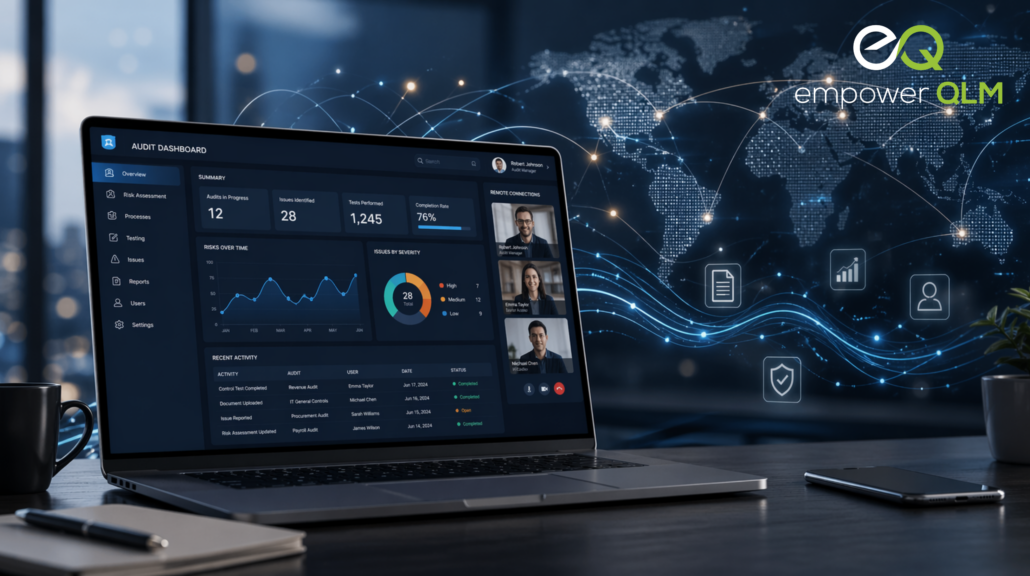
A hybrid model becomes much more credible when audit scheduling, checklists, dashboards, supplier comparisons, action-item closure, PPAP workflows, supplier portals, scorecards, certificates, CAPA, and document control are connected rather than scattered across disconnected systems. That digital layer is what turns remote review from a stopgap into a governed method.
For example, RGBSI provides EmpowerQLM as a tool for connecting audits, workflows, scorecards, corrective action, and supplier records within a shared quality architecture. With 250+ global quality resources and having done 13,000+ annual PPAPs, there is one undeniable truth: hybrid oversight works best when service execution and digital infrastructure reinforce
each other.
Conclusion
Onsite audits are still essential. But in large manufacturing networks, they should no longer be asked to do all the work.
An onsite-only supplier audit model breaks down at enterprise scale because it cannot deliver enough coverage, consistency, and follow-through across a dispersed and risk-diverse supplier base. The more resilient alternative is not to eliminate plant visits. It is to reposition them inside a broader, risk-based system that combines offsite assessment, remote review, specialist input, and connected corrective-action workflows.
That is the shift underway in supplier quality. The organizations adapting fastest are not abandoning rigor. They are reallocating it.
FAQ
Are onsite supplier audits still necessary?
Yes. For high-risk, unstable, launch-critical, or operationally ambiguous suppliers, onsite audits remain essential. The argument is not against onsite visits. It is against using them as the only scalable method of supplier oversight.
What is a hybrid supplier audit model?
A hybrid supplier audit model combines structured self-assessment, offsite review, remote document and PPAP evaluation, compliance support, and targeted onsite visits. Its purpose is to extend coverage across the full supplier base while concentrating physical audits where they add the most value.
Why do onsite-only audits become inconsistent?
Because enterprise supplier networks are too diverse for every audit to be equally deep or comparable when they depend heavily on individual auditors, travel schedules, and limited time on site. Inconsistency is usually a design problem, not an effort problem.
How do weak supplier audits affect PPAP?
Weak upstream audit systems often allow documentation gaps, process-control issues, and readiness problems to survive into PPAP review. That can lower first-time-through rates, extend
approval cycles, and increase launch risk.
What makes remote or offsite audit methods credible?
They become credible when they are standardized, evidence-based, risk-scored, and connected to CAPA, scorecards, certificate status, and approval workflows. Remote review
without a disciplined system underneath it is just paperwork with better Wi-Fi.
About Us
RGBSI’s quality services division and empowerQLM help manufacturers build that more preventive model. RGBSI supports supplier assessments, onsite and remote audits, PPAP and re-PPAP activity, supplier development, crisis management, and compliance or sustainability work across global supply bases, including automotive and aerospace-focused quality environments. Relevant service areas include quality audits and assessments and product compliance and sustainability services.
On the software side, empowerQLM’s connected platform includes supplier certificates, KPI scorecards, supplier risk assessment, audit management, CAPA and nonconformance management, inspection, material compliance, ESG and EHS workflows, and integrated eRFQ support. That combination allows quality leaders to move from retrospective supplier grading to forward-looking supplier governance, with consolidated scoring and trend visibility that can inform both intervention and sourcing decisions.
Download Empower QLM Software Overview Brochure