
Your PFMEA Changed. Why Didn’t the Control Plan?
Why linked PPAP elements matter when manufacturing risk changes
Quick answer: A PFMEA change should trigger a controlled review of the connected control plan, work instructions and inspection requirements. The documents do not need to contain identical information, and not every change requires every downstream record to be revised. They do need to remain technically consistent and traceable.
A Complete PPAP Package Can Still Contradict Itself
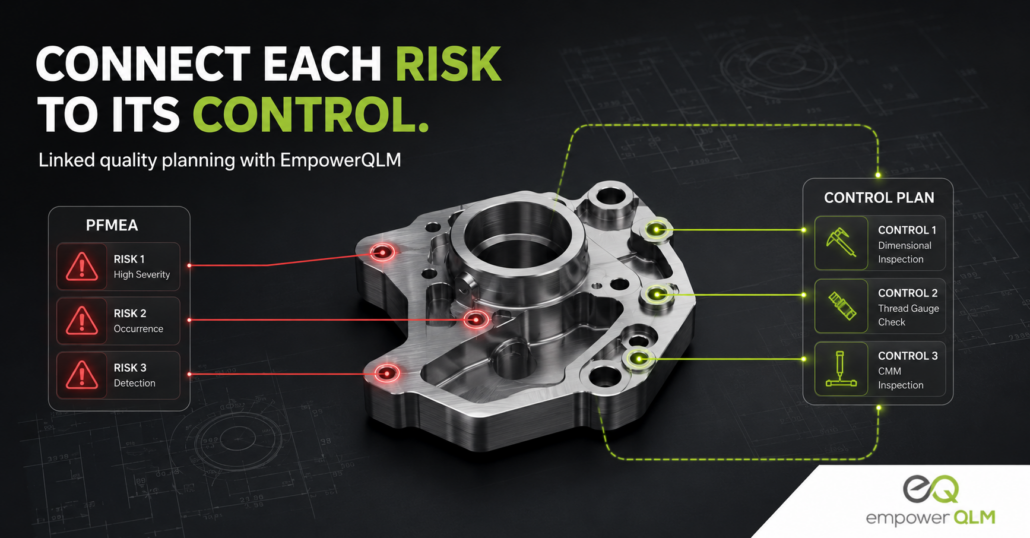
A supplier updates a PFMEA after identifying a new cause of variation at a machining operation. The revised analysis adds a prevention control and strengthens detection. The PFMEA is approved, filed and technically complete. The control plan, however, still references the former controls. The work instruction has not changed, and the inspection plan still references the former characteristic, measurement method or sampling frequency.
On paper, every required PPAP element exists. Operationally, the risk response stopped inside the PFMEA.
This is the core weakness of document-by-document quality planning. DFMEA, DVP&R, process flow diagrams, PFMEA, control plans, work instructions and inspection plans are often created by different people in different templates. Without explicit relationships, the organization depends on memory and manual cross-checking to keep the chain aligned.
The PFMEA and Control Plan Solve Different Parts of the Same Problem
The PFMEA evaluates how a manufacturing process can fail, what may cause the failure, what the effects could be and which prevention or detection controls address the risk. The control plan translates selected process and product controls into an operational method, including what is controlled, how it is measured, how often it is checked and what reaction is required when the process moves out of control.
They should not be carbon copies. They should agree where their information intersects. A special characteristic identified through risk analysis should remain controlled through the control plan and, where applicable, through work instructions, error-proofing or inspection activities. When a PFMEA prevention or detection control is reflected in the control plan, its connection to the relevant process step, characteristic and risk should remain clear. A changed process step should not remain mapped to an obsolete work instruction.
The current AIAG Quality Core Tools framework treats APQP, Control Plan, PPAP, FMEA, MSA and SPC as related disciplines. Managing their outputs as unrelated files undermines that relationship.
Why Core Tool Linkages Break
Each Document Has a Different Owner
Design engineering may own the DFMEA and DVP&R. Manufacturing engineering may build the process flow and PFMEA. Quality may maintain the control plan and inspection requirements. Production may own the work instruction. Each function can update its own record correctly while the overall system drifts out of alignment.
File Storage Is Mistaken for Traceability
A document management system can preserve revisions and approvals. That is useful, but it does not automatically establish why a PFMEA control is connected to a particular control-plan characteristic or which inspection requirement depends on it. Version control answers which file is current. Relationship traceability answers what the change affects.
Reviews Happen at Milestones Instead of at the Point of Change
Teams often discover inconsistencies during a PPAP review, customer submission, launch gate or audit. The better control is to evaluate affected elements when the change is made, while the reason and technical context are still clear.
What a Controlled Change Review Should Establish
When an FMEA or process element changes, the review should answer practical questions: Which requirement or characteristic is affected? Does the DVP&R still verify the relevant design risk? Does the process flow show the current operation and sequence? Do PFMEA prevention and detection controls reflect the actual process? Does the control plan carry the necessary controls and reaction plan? Do work instructions tell the operator what to do? Does inspection collect evidence against the current specification? Should Reverse FMEA challenge the revised control on the shop floor?
The correct answer is not always to revise every document. Some changes have no downstream effect. The organization should be able to show that connected elements were considered and the decision was documented. That is the difference between mechanical updates and defensible change-impact control.
How Empower QLM Connects PPAP Elements
Empower QLM’s AIAG-VDA Linked PPAP Elements Creation capability is designed to maintain information flow across requirements, DFMEA, DVP&R, process flow diagrams, PFMEA, control plans, work instructions, inspection and Reverse FMEA. Teams can manage them as connected
parts of the product and process-quality model instead of isolated attachments.
The module supports a model-based systems engineering and V-model approach. It can carry severity ratings and hazard classifications across System FMEA, Design FMEA and Process FMEA, helping teams preserve the context of risk as analysis moves from system and design decisions into manufacturing controls.
DFMEA can be used with boundary diagrams, interface matrices and P-diagrams. Foundation FMEAs, reusable process libraries, process blocks and product families help organizations reuse established knowledge without rebuilding every analysis from scratch. The platform also supports FMEA-MSR integration, AIAG-VDA and AIAG Fourth Edition formats, and conversation capabilities for cross-functional collaboration. The AIAG manuals catalog identifies the AIAG-VDA FMEA Handbook as the automotive reference for Design FMEA, Process FMEA and Supplemental FMEA for Monitoring and System Response.
Linkage does not mean the software should blindly rewrite approved records. It means engineers and quality teams can preserve the relationships needed to review changes with context, maintain technical consistency and demonstrate how risk information flows across PPAP elements.
A Shared Folder Holds Documents. A Linked System Holds the Logic
Manufacturers do not lose control because they lack PFMEAs or control plans. They lose control because the documents stop agreeing after a product, process, supplier or risk assumption changes. The resulting gap may appear as an audit finding, a delayed PPAP, an ineffective inspection or a control that exists in a spreadsheet but not in production.
Empower QLM helps manufacturers connect the technical elements behind PPAP so a change can be evaluated across the records that define product risk, process risk and shop floor control. Explore the broader Empower QLM PPAP and linked-element capabilities to see how connected quality planning can replace document-by-document reconciliation.
Frequently Asked Questions
Must the PFMEA and Control Plan Contain Identical Information?
No. The documents serve different purposes. They should be consistent where they share process steps, characteristics, controls, detection methods and reaction logic.
Does Every PFMEA Change Require a Control-Plan Revision?
No. The change should trigger an impact review. If the revised risk, cause, control or characteristic affects production control, inspection or operator execution, the relevant downstream record should be updated. If it does not, the review decision should still be traceable.
Can a Shared Drive Provide PPAP-Element Traceability?
A shared drive can store current files and revision histories. It generally does not create explicit relationships between a failure mode, process step, control-plan characteristic, work instruction and inspection requirement. Those relationships must otherwise be reconstructed manually.
What Is Linked PPAP-Element Software?
Linked PPAP-element software connects quality-planning records so teams can follow information from requirements and design risk through process risk, controls, work instructions and inspection. The goal is consistent, reviewable information flow across the PPAP package.
About Us
RGBSI’s quality division and EmpowerQLM software address the COPQ problems covered in this article through a combined services and platform model. RGBSI supports manufacturers with COPQ baseline studies, supplier chargeback recovery programs, PPAP and APQP execution support, supplier development, audits, 8D problem solving, and warranty-related quality services. These services help manufacturers identify hidden cost categories, quantify supplier-driven losses, and establish defensible recovery mechanisms.
EmpowerQLM provides the workflow infrastructure to operationalize that model. NC Management captures nonconformances at the point of failure. CoPQ Management links cost fields, chargeback workflows, and recovery status to NCs, 8Ds, CAPAs, PPAPs, and warranty records. Warranty Management connects field claims to financial exposure and recurrence analysis. Supplier Scorecards bring quality cost into supplier performance discussions. ERP and finance-system integration support debit and credit note tracking, so quality cost can move from hidden overhead to attributable financial governance.
Together, RGBSI and EmpowerQLM help enterprise manufacturers make COPQ visible, recoverable, and preventable. More detail on the services side is available through EmpowerQLM Quality Management Services.
Download Empower QLM Software Overview Brochure