
Empower QLM APQP Program Management
Supplier-driven APQP execution with configurable quality planning, risk control, and project visibility
Bringing new products, parts, or suppliers into production requires tight coordination across quality, engineering, purchasing, compliance, and supplier teams. When APQP activity depends heavily on internal APQP engineers to chase tasks, review progress, and manage handoffs, programs
slow down and risk becomes harder to control.
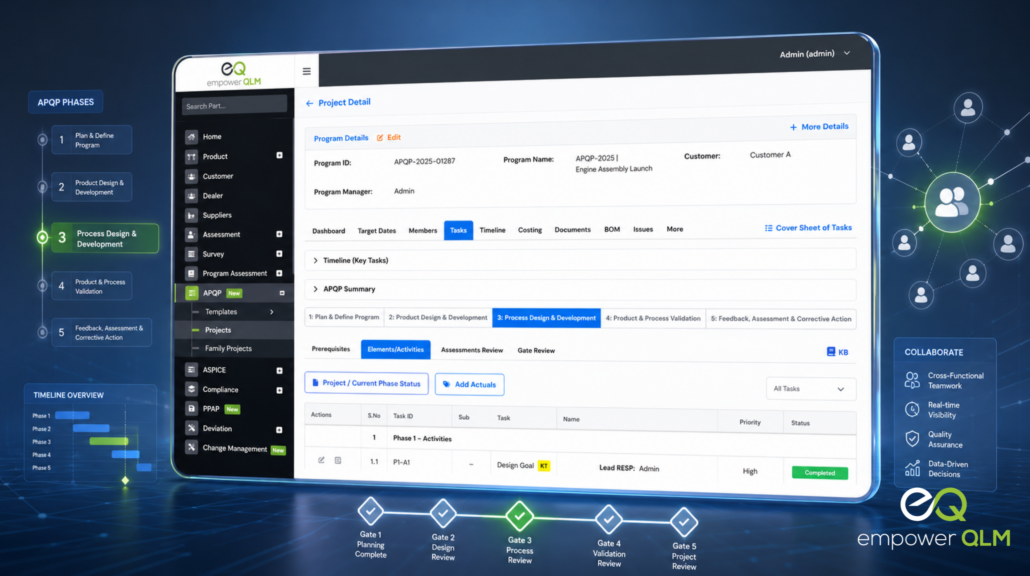
Empower QLM APQP Program Management helps organization’s structure, manage, and track APQP projects across the full planning lifecycle. The module enables suppliers to manage their own APQP projects within a defined, configurable process, reducing the day-to-day involvement required from client APQP engineers while maintaining visibility, accountability, and process discipline.
Built to support automotive and manufacturing quality requirements, the module can be configured around AIAG standards, VDA standards, or organization-specific APQP business requirements. Teams can define the phases, tasks, deliverables, milestones, and gate reviews needed for each program, creating a repeatable APQP framework without forcing every business unit, supplier, or product line into the same rigid workflow.
Built for controlled APQP execution, not manual follow-up
APQP programs often fail because the work is fragmented: timelines live in one place, deliverables in another, risk tracking somewhere else, and supplier updates buried in email. Empower QLM APQP Program Management brings these activities into a structured program environment where project status, deliverables, milestones, and risks can be managed with greater consistency.
Suppliers can take ownership of their assigned APQP activities, helping client teams shift from task-chasing to exception management. This allows APQP engineers to focus more time on high-risk programs, critical gate reviews, and quality decision-making instead of routine project
administration.
What the module enables
Supplier-managed APQP projects
EmpowerQLM allows suppliers to manage their own APQP projects within the client’s defined process. This reduces the administrative burden on internal APQP engineers while keeping supplier activity aligned to expected phases, deliverables, and milestones.
Configurable APQP process framework
The module supports configurable APQP processes based on AIAG, VDA, or custom business requirements. Organizations can adapt the process to fit customer expectations, regional standards, product complexity, or internal quality procedures.
Configurable phases, tasks, deliverables, milestones, and gate reviews
Teams can define the APQP structure that fits their program model. By configuring phases, task lists, required deliverables, milestones, and gate reviews, quality leaders can create a consistent execution path while preserving flexibility for different project types.
Built-in risk management
Risk is managed directly within the APQP workflow through risk flags, risk evaluation, and risk mitigation actions. This helps teams identify potential issues earlier, evaluate their impact, and drive corrective action before risks turn into launch delays or quality escapes.
Project timeline tracking with Gantt charts
The module allows teams to create project timelines and monitor progress using Gantt charts. This gives program stakeholders a clearer view of timing, dependencies, and milestone status, making it easier to spot schedule pressure before it affects launch readiness.
Connected quality lifecycle processes
APQP Program Management integrates with related Empower QLM capabilities, including BOM Traceability, PPAP Management, Change Management, e-RFI/RFQ, Material Compliances, and other lifecycle processes. This helps organizations connect planning activity with the broader quality and supplier management ecosystem instead of treating APQP as an isolated project tracker.
Business intelligence dashboards
Integration with a Business Intelligence tool enables the creation of user-specific dashboards, giving stakeholders visibility into the APQP information most relevant to their role. Leadership can monitor program health, quality teams can focus on risk and deliverables, and project owners can
track execution status.
Business value
Reduce APQP engineering workload
By enabling suppliers to manage their own APQP projects, Empower QLM reduces the amount of manual follow-up required from client APQP engineers. Internal teams remain involved where they add the most value: reviewing progress, managing risk, and supporting critical quality decisions.
Improve consistency across APQP programs
Configurable processes help standardize how APQP work is planned, executed, reviewed, and measured. Whether the organization follows AIAG, VDA, or internal requirements, the module helps teams apply a consistent structure across suppliers and programs.
Strengthen launch readiness
Milestones, deliverables, timelines, and gate reviews give teams a clearer view of whether APQP work is progressing as expected. Risk flags and mitigation actions help surface problems earlier, supporting better preparation before production launch.
Increase supplier accountability
When suppliers manage their APQP activities directly, ownership becomes clearer. Tasks, deliverables, timelines, and risks are visible within the project structure, helping reduce ambiguity and improve follow-through.
Connect APQP to the broader quality lifecycle
Integration with BOM traceability, PPAP, change management, RFx activity, material compliance, and related processes help ensure APQP decisions are connected to the data and workflows that influence quality outcomes.
Give stakeholders the visibility they need
Role-specific dashboards help teams move away from static status reports and fragmented updates. Users can focus on the APQP metrics, risks, deliverables, and timelines that matter most to their responsibilities.
Why it matters
APQP is not just a checklist. It is the foundation for preventing quality problems before production begins. When APQP is managed through disconnected tools and manual coordination, teams lose time, visibility, and control.
Empower QLM APQP Program Management gives manufacturers and suppliers a structured way to manage APQP execution, control risk, track timelines, and maintain alignment across related quality lifecycle processes. The result is a more disciplined APQP process, stronger supplier
accountability, and better visibility into launch readiness.
Schedule a Discovery Call
Ready to bring more structure, visibility, and supplier accountability to APQP execution?
Schedule a discovery call with the Empower QLM team to discuss how APQP Program Management can support your launch, supplier quality, and quality lifecycle management goals.
FAQ
What is APQP?
APQP stands for Advanced Product Quality Planning. It is a structured approach used by manufacturers to plan and manage the quality activities required before production launch. APQP helps teams define deliverables, manage timing, review readiness, and reduce quality risk before a
product reaches production.
How does Empower QLM support AIAG and VDA APQP requirements?
Empower QLM APQP Program Management supports configurable APQP processes that can be aligned to AIAG standards, VDA standards, or other APQP business requirements. Teams can configure phases, tasks, deliverables, milestones, and gate reviews to match the APQP structure required by their organization, customer, or industry.
How does the APQP module manage risk?
The module includes built-in risk management through risk flags, risk evaluation, and risk mitigation actions. APQP teams can identify risks, evaluate them, and manage mitigation activity within the APQP project structure. This helps teams address risk earlier and keep mitigation tied to
program execution.
How does APQP Program Management integrate with PPAP and BOM Traceability?
Empower QLM APQP Program Management integrates with PPAP Management and BOM Traceability, along with Change Management, e-RFI/RFQ, Material Compliances, and other modules. This allows APQP activity to stay connected to related quality lifecycle processes, including production part approval, product structure, engineering changes, sourcing activity, and compliance requirements.
Who should use Empower QLM APQP Program Management?
The module is designed for quality leaders, supplier quality engineers, APQP program managers, and supply chain executives at OEMs and Tier 1/2 manufacturers. It is especially relevant for automotive, aerospace, and industrial manufacturers that need structured APQP execution across suppliers, plants, programs, and launch teams.
How do suppliers use the APQP module?
Suppliers can manage their own APQP projects inside Empower QLM. This gives suppliers direct responsibility for their APQP tasks, deliverables, milestones, and project activity while reducing the level of manual involvement required from client APQP engineers.
About Us
RGBSI’s quality division and EmpowerQLM software address the COPQ problems covered in this article through a combined services and platform model. RGBSI supports manufacturers with COPQ baseline studies, supplier chargeback recovery programs, PPAP and APQP execution support, supplier development, audits, 8D problem solving, and warranty-related quality services. These services help manufacturers identify hidden cost categories, quantify supplier-driven losses, and establish defensible recovery mechanisms.
EmpowerQLM provides the workflow infrastructure to operationalize that model. NC Management captures nonconformances at the point of failure. CoPQ Management links cost fields, chargeback workflows, and recovery status to NCs, 8Ds, CAPAs, PPAPs, and warranty records. Warranty Management connects field claims to financial exposure and recurrence analysis. Supplier Scorecards bring quality cost into supplier performance discussions. ERP and finance-system integration support debit and credit note tracking, so quality cost can move from hidden overhead to attributable financial governance.
Together, RGBSI and EmpowerQLM help enterprise manufacturers make COPQ visible, recoverable, and preventable. More detail on the services side is available through EmpowerQLM Quality Management Services.
Download Empower QLM Software Overview Brochure