
Your Supplier Scorecard Isn’t Telling You Who Will Fail Next
Most supplier scorecards answer an important but incomplete question: how did a supplier perform last month or last quarter? Executive teams need a different answer: which supplier is most likely to disrupt revenue, launch timing, compliance posture, or brand reputation next?
That distinction matters because past performance is a lagging indicator. It tells you what has already gone wrong. It rarely tells you what is about to break. Manufacturers operating under IATF 16949, PPAP-intensive launch models, AS9100, and the broader defense compliance environment need a broader view of supplier risk than ppm, delivery, and quarterly quality ratings alone. In practice, that means combining quality history with financial resilience, certification and document health, ESG and social-governance exposure, audit findings,
capacity signals, and cybersecurity or controlled-information risk.
Traditional scorecards are not obsolete. They are simply incomplete. Many enterprise teams already use them well. The emerging evidence is that scorecards become materially more
predictive when they stop functioning as a backward-looking report card and start functioning as a consolidated risk model.
Why supplier surprises happen even when the scorecard looks acceptable
Supplier failures rarely arrive as a single dramatic event. They accumulate quietly across disconnected signals.
A Tier 2 automotive supplier can pass PPAP dimensional checks, submit acceptable documentation, and still be moving into financial distress. Delivery remains stable because the supplier is preserving customer-facing output while stretching payables, deferring maintenance, and reducing process discipline internally. The scorecard stays green because the scorecard is measuring the symptoms that appear last, not the conditions that form first. The same logic underpins the view that PPAP should be treated as a risk-control system rather than a paperwork event, not just an approval milestone, as outlined in PPAP Management at Scale: Turning a Compliance Event into a Strategic Risk-Control System.
In aerospace and defense, the pattern is similar, but the exposure is broader. A machining or electronics supplier may retain AS9100 certification and appear operationally stable, while accumulating environmental, labor, sourcing, or cybersecurity issues that raise questions about customer eligibility, controlled-information handling, or contractual compliance. AS9100 remains foundational, but it does not by itself answer whether the supplier is keeping pace with the quality, security, and governance demand surrounding defense work.
This is why supplier surprises feel so frustrating to leadership teams. The data was often present. It just was not assembled into a decision framework.
What a forward-looking supplier risk model should actually include
At executive level, a practical supplier risk model needs five dimensions.
Quality execution. This is the familiar layer: ppm, delivery, escapes, audit performance, PPAP status, repeat nonconformances, 8D effectiveness, and launch readiness.
Financial resilience. Credit deterioration, liquidity concerns, abrupt commercial changes, and financial survey signals often move before quality collapse becomes visible.
Compliance and document health. Expiring IATF or AS9100 certificates, incomplete NDA or regulatory documentation, CMRT and EMRT gaps, material compliance issues, and overdue approvals are all meaningful indicators.
ESG and social-governance exposure. Environmental gaps, supplier social responsibility issues, country-of-origin concerns, forced-labor exposure, EHS findings, and governance weaknesses increasingly influence sourcing and reputation risk.
Business continuity and operational strain. Capacity declarations, run-at-rate shortfalls, change volatility, tooling risk, special-process instability, and cybersecurity exposure all change the probability of future disruption.
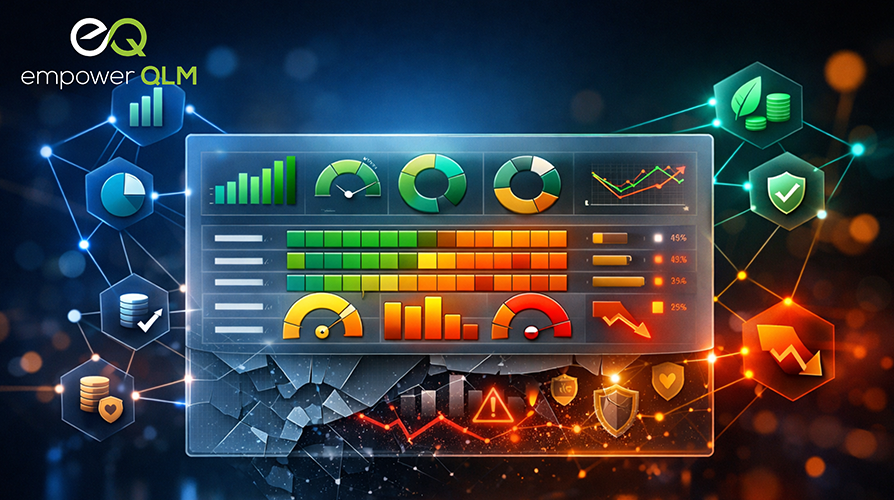
That is not a theoretical model. RGBSI’s current empowerQLM module set describes supplier risk assessment as a consolidated score built from financial, ESG, performance, and compliance parameters, with historical trend tracking, document health checks, ESG self-assessment, and sourcing support through integrated eRFQ workflows. Supplier scorecards, supplier certificates, and related sourcing inputs are positioned as connected, not standalone, processes.
Automotive and aerospace examples make the gap visible
Consider an automotive launch under IATF 16949 with heavy PPAP governance. The supplier scorecard shows acceptable delivery and recent quality performance. PPAP submissions are advancing. Yet the supplier’s certificate renewal is approaching expiry, capacity assumptions have not been revalidated after a tooling move, and recent audit observations point to
deterioration in control-plan discipline. Add worsening financial survey data and a missing conflict-minerals declaration, and the actual risk profile looks very different from the dashboard headline. The issue is not that the scorecard was wrong. It was answering the wrong question.
Now consider an aerospace supplier with FAIR and AS9100 discipline in place. Product conformity may still be acceptable, yet unresolved EHS findings, ESG red flags, or controlled-information weaknesses can change customer confidence faster than ppm data will.
In regulated sectors, supplier risk is no longer limited to defect risk. It is also contract risk, compliance risk, program risk, and public-trust risk.
The real problem is fragmentation, not lack of effort
Most enterprise manufacturers already possess much of the necessary information. What they lack is integration.
Quality data lives in scorecards, audits, PPAP workflows, CAPA systems, inspection records, and ERP extracts. ESG evidence lives in surveys, assessments, spreadsheets, and supplier correspondence. Compliance documents live in shared drives, inboxes, or specialist systems. Financial signals sit with procurement or supplier development. Sourcing decisions happen in yet another workflow.
When those signals stay separated, teams respond reactively. Quality reacts to escapes. Procurement reacts to financial news. Compliance reacts to missing declarations. Sustainability reacts to a customer escalation. None of those reactions is irrational. They are just late.
This is closely related to two other failure patterns already visible in large manufacturing organizations. One is the way APQP discipline weakens when launch management becomes status reporting instead of risk closure, a problem explored in Why APQP Fails at Scale and How Digital Program Management Restores Launch Discipline. The other is the way corrective-action systems often optimize for closure rather than recurrence control, as examined in Why Most CAPA Systems Don’t Actually Prevent Recurrence. Supplier risk governance sits directly on top of both problems.
How preventive supplier governance works at scale
The shift from firefighting to prevention is less about buying a new dashboard and more about changing operating logic.
First, normalize risk inputs into a common framework. A late certificate renewal, declining audit score, repeated NC, missing CMRT, and deteriorating financial rating should all roll into a shared view of supplier exposure, even if they originate in different systems.
Second, weight risk by business criticality. A high-risk supplier for a sole-source defense component is not the same as a low-complexity, multi-source indirect supplier. Executives need exposure tied to commodity, program, plant, and customer context.
Third, evaluate trend and velocity, not just status. A supplier at 82 points that has deteriorated for three consecutive quarters may deserve more attention than a supplier at 75 that is steadily improving under a validated recovery plan.
Fourth, link visibility to action. High-risk suppliers should trigger targeted responses: financial review, document chase, onsite audit, ESG assessment, capacity study, revalidation PPAP, or sourcing contingency planning. Medium-risk suppliers may require tighter certificate monitoring
and more frequent business review. Low-risk suppliers should not absorb disproportionate management attention.
Fifth, bring risk into sourcing before nomination. If eRFQ decisions are disconnected from audits, scorecards, nonconformances, and certificate status, the organization is still treating supplier risk as an after-the-fact quality issue. It is a business decision variable and should be visible at award stage. This is precisely where connected workflows such as Empower QLM modules and integrated sourcing inputs become strategically useful, especially when supplier certificates, scorecards, and eRFQ are evaluated together rather than independently.
What executives should ask their teams now
A simple test is to ask three questions.
If one of your top twenty suppliers failed unexpectedly next quarter, which signals would explain it?
Which of those signals are already available somewhere in your organization today?
Which of them are visible in one place before a disruption occurs?
If the answers come back from multiple systems, multiple functions, and multiple spreadsheet owners, the organization does not have a supplier risk model yet. It has supplier risk fragments.
That is not a criticism of current practice. It is a reflection of how enterprise supply chains evolved. Quality, sourcing, compliance, and sustainability systems were built for legitimate reasons at different times. The next step is not to discard them. It is to make them intelligible together.
About Us
RGBSI’s quality services division and empowerQLM help manufacturers build that more preventive model. RGBSI supports supplier assessments, onsite and remote audits, PPAP and re-PPAP activity, supplier development, crisis management, and compliance or sustainability work across global supply bases, including automotive and aerospace-focused quality environments. Relevant service areas include quality audits and assessments and product compliance and sustainability services.
On the software side, empowerQLM’s connected platform includes supplier certificates, KPI scorecards, supplier risk assessment, audit management, CAPA and nonconformance management, inspection, material compliance, ESG and EHS workflows, and integrated eRFQ support. That combination allows quality leaders to move from retrospective supplier grading to forward-looking supplier governance, with consolidated scoring and trend visibility that can inform both intervention and sourcing decisions.
Download Empower QLM Software Overview Brochure